A track toy is deceptively simple: a set of rails, connectors, and a small car. Yet that simplicity hides a rich learning environment. When children build tracks, run cars, watch failures, and redesign, they’re practicing the scientific method, exercising spatial reasoning, and building resilience.
로서 최고의 장난감 공급업체, Chengji knows how this influences kids’ independent problem-solving capability. Let us, therefore, explain how track toy sets foster independent problem-solving, offer activity ideas to amplify learning, and recommend age-appropriate product features to maximize cognitive growth.
Cause-and-effect Learning: Foundation of Problem-solving
The first lesson a child learns from a 트랙 장난감 is cause and effect. Changing a slope, swapping a curve, or adjusting a launcher immediately alters the car’s behavior. That instant feedback loop is powerful because:
- It makes abstract physics visible (speed, gravity, friction).
- It encourages quick hypothesis testing: “If the slope is steep like that, it may need a higher initial velocity.”
- It rewards experimentation — success appears as a running car, failure as a stopped one, both prompting analysis.
This low-stakes, immediate feedback is ideal for independent learners. Kids don’t need to wait for adult instruction; they form hypotheses, test them, and iterate.

Spatial Reasoning and Mental Simulation
Before a child lays a single piece, they often picture the layout in their head. Visualizing a continuous route — where a curve goes, how many pieces a bridge needs, which angle will let the car pass — strengthens spatial reasoning. Repeatedly imagining and then building trains the brain to:
- Mentally rotate pieces and predict outcomes,
- Sequence assembly steps, and
- Anticipate failure points before they happen.
A 트랙 장난감 encourages this internal planning because the construction is tactile and the consequences are easy to observe.
Trial, Error, and Deliberate Iteration
Independent problem-solving thrives on iteration. A child builds a track, sees the car derail, and tries a new approach. This pattern mirrors research-based learning cycles:
- Design — choose pieces and layout.
- Test — run the car.
- Observe — identify the failure (speed loss, derailment, insufficient momentum).
- Modify — change a slope, add a support, shorten a curve.
- Re-test.
Through this pattern, children learn to isolate variables (only change one thing at a time), draw cause-and-effect links, and persist until the solution works. Over time, they internalize a methodical approach rather than relying on guesswork.

Development of Executive Function and Planning Skills
Working with a 트랙 장난감 exercises executive functions: planning, working memory, and inhibitory control.
- Planning: Deciding the sequence of pieces and anticipating resources (how many straight/curved segments).
- 작업 메모리: Holding a route idea in mind while assembling different parts.
- Inhibitory control: Resisting the impulse to rebuild the whole track after a small failure and instead trying a targeted fix.
These cognitive skills transfer to classroom tasks, homework planning, and everyday problem-solving.
Emotional Resilience: Learning to Fail in Safety
Failure is an important component of learning, but children should have safe environments in which to fail. A 트랙 장난감 is exactly this environment.
A failed run can be disappointing, but it does not evoke fear. And if the 트랙 장난감 is properly disturbed, failure will always include an emotional reaction that can be accompanied by a few teachings. These risks of small failures will teach:
- Emotional regulation (breathing and trying again).
- Persistence (rebuilding for the next time).
- Analytical reflection (what specifically failed and why).
Children who can learn to handle their own frustration through constructive undertakings will be better able to solve problems in the future.

Creativity and Divergent Thinking
A 트랙 장난감 is rarely a single-use object. A straight piece can become a bridge or a ramp depending on context. This versatility prompts creative problem-solving:
- Children repurpose parts from other toys.
- They invent new missions (get the car to the top of a stack).
- They combine storytelling with engineering (build a rescue route for a character).
Such open-ended play supports creative thinking — a key component of complex problem solving.
Scaling Complexity: Age-appropriate Progression
To nurture independence, choose 트랙 장난감s that scale with difficulty.
- Ages 3–5: Simple snap tracks, slow push cars, and wide connectors. Focus: cause-and-effect, hand-eye coordination.
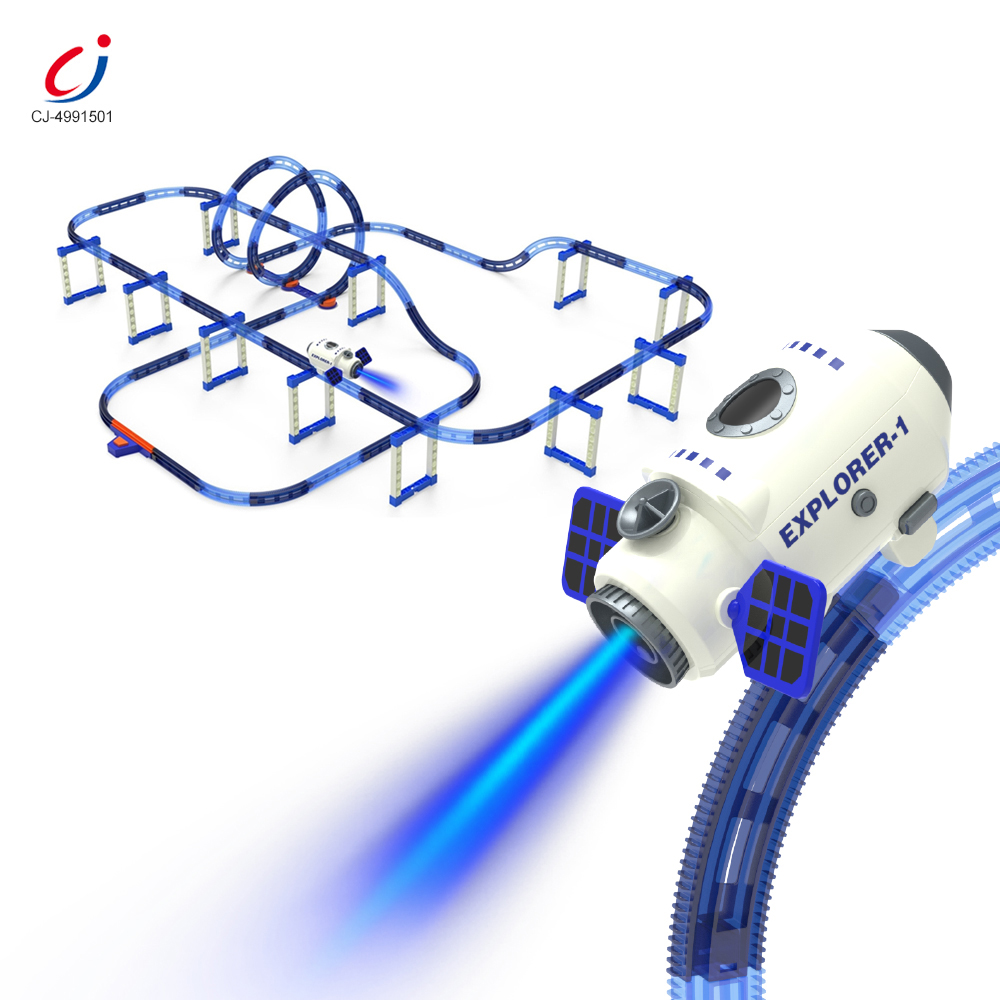
- Ages 5–8: Launchers, loops, multi-level platforms. Focus: planning, sequencing, and troubleshooting at higher speeds.
- Ages 8+: Modular engineering kits with motors, sensors, or programmable elements. Focus: systems thinking and basic STEM concepts.
Scaling allows children to encounter challenges slightly above their current level — the zone where real problem solving develops.
Activities that Promote Independent Problem-solving
These simple exercises turn a 트랙 장난감 session into a focused problem-solving lab.
- The One-Change Challenge
- Goal: Fix a broken run by changing only one piece.
- Benefit: Teaches variable isolation and hypothesis testing.
- Gravity Puzzle
- Build a track where the car must climb a gentle slope without losing momentum.
- Benefit: Encourages thinking about energy and friction.
- Limited Parts Build
- Give a strict number of pieces and ask for the longest possible working route.
- Benefit: Promotes resource planning and optimization.
- Timed Optimization
- Aim for the fastest run; each iteration must come with one planned modification.
- Benefit: Iterative improvement and performance analysis.
- Design a Rescue Mission
- Create an obstacle course where the car must reach a stranded figure.
- Benefit: Integrates storytelling with engineering constraints.
These activities are intentionally low-intervention: adults set the problem and step back to let children experiment.
Role of Parents and Educators: Scaffold, Don’t Solve
To help children develop autonomy:
- Ask guiding questions: “What do you think will happen if you change that module?”
- Encourage hypothesis-driven play: prompt them to predict before testing.
- Resist immediate fixes: allow time for self-correction.
- Offer minimal tools: a ruler, tape, or a bridge support, but not the solution.
This approach preserves the child’s ownership of the problem and reinforces independent thinking.
Choosing a Track Toy that Fosters Independence
Look for features that invite exploration:
- Modularity — interchangeable parts for many configurations.
- Visible mechanics — track pieces that show cause/effect clearly (transparent loops, open ramps).
- Durability — sturdy connectors reduce frustration from breakage.
- Expandability — extension packs encourage long-term iteration.
- Age-appropriate safety — pieces sized to avoid choking hazards.
A thoughtfully designed 트랙 장난감 becomes a perpetual problem-solving toolkit rather than a one-off gift.
Classroom and Therapeutic Applications
Educators can use track toys for structured lessons: introduce basic physics vocabulary, run measurement experiments (timing runs), and document iterations. Therapists employ tracks to teach sequencing and emotional regulation in a tangible, motivating way. The key is documentation: children learn metacognition, which means the ability to self-monitor and adjust one’s own learning and problem-solving process, when they record what changed and why it worked.
결론
A 트랙 장난감 is an ideal platform for independent problem-solving. It embeds scientific reasoning, spatial planning, emotional resilience, and creative thinking into a play cycle that children can run themselves. For parents, educators, and toy buyers, the takeaway is clear: choose modular, scalable track systems and step back. When kids tinker, test, and triumph on their own, they don’t just win a race — they learn how to think. And that is worthy advertising when making a promotion.
청지 소개

청지는 최고의 장난감 공급업체, providing kids’ toy wholesale supply, like track toy wholesale supply, for brands, retailers, and wholesalers worldwide.
Our production facility operates under international manufacturing and safety standards, ensuring each item meets strict durability and compliance requirements. With a broad catalog covering multiple toy categories, we help buyers build assortments that fit their market needs.
For specialized projects, we provide 맞춤형 장난감 솔루션 that integrate design input, material selection, and controlled engineering steps. Reliable output, consistent quality, and responsive service make Chengji a supplier you can trust.