Review inventory, prepare for after-sales issues, and turn this season’s results into a practical sourcing plan for the year ahead.
Black Friday and Cyber Monday (BFCM) may be over, but a toy buyer’s Q4 decisions are not. Christmas selling continues, customer feedback is still developing, and the next production plan needs attention before the year ends.
In 2026, Black Friday fell on November 27 and Cyber Monday on November 30, as confirmed in Amazon’s event calendar. That makes early December a useful point to review the first results and decide what happens next.
For importers, wholesalers and e-commerce sellers, the priorities are connected: identify which stock deserves more investment, understand which product or packaging issues need attention, and confirm a realistic timetable for 2027 replenishment. A strong sales weekend only becomes a strong season if the decisions afterwards protect the margin.
1. Review Inventory Before Placing Another Order
Start with a SKU-level review rather than a single total-sales figure. Export units sold, usable stock, reserved quantities, confirmed inbound stock, selling price, promotional spend, and the first return signals. Separate damaged, quarantined, and uninspected returned goods from stock that is ready to sell.
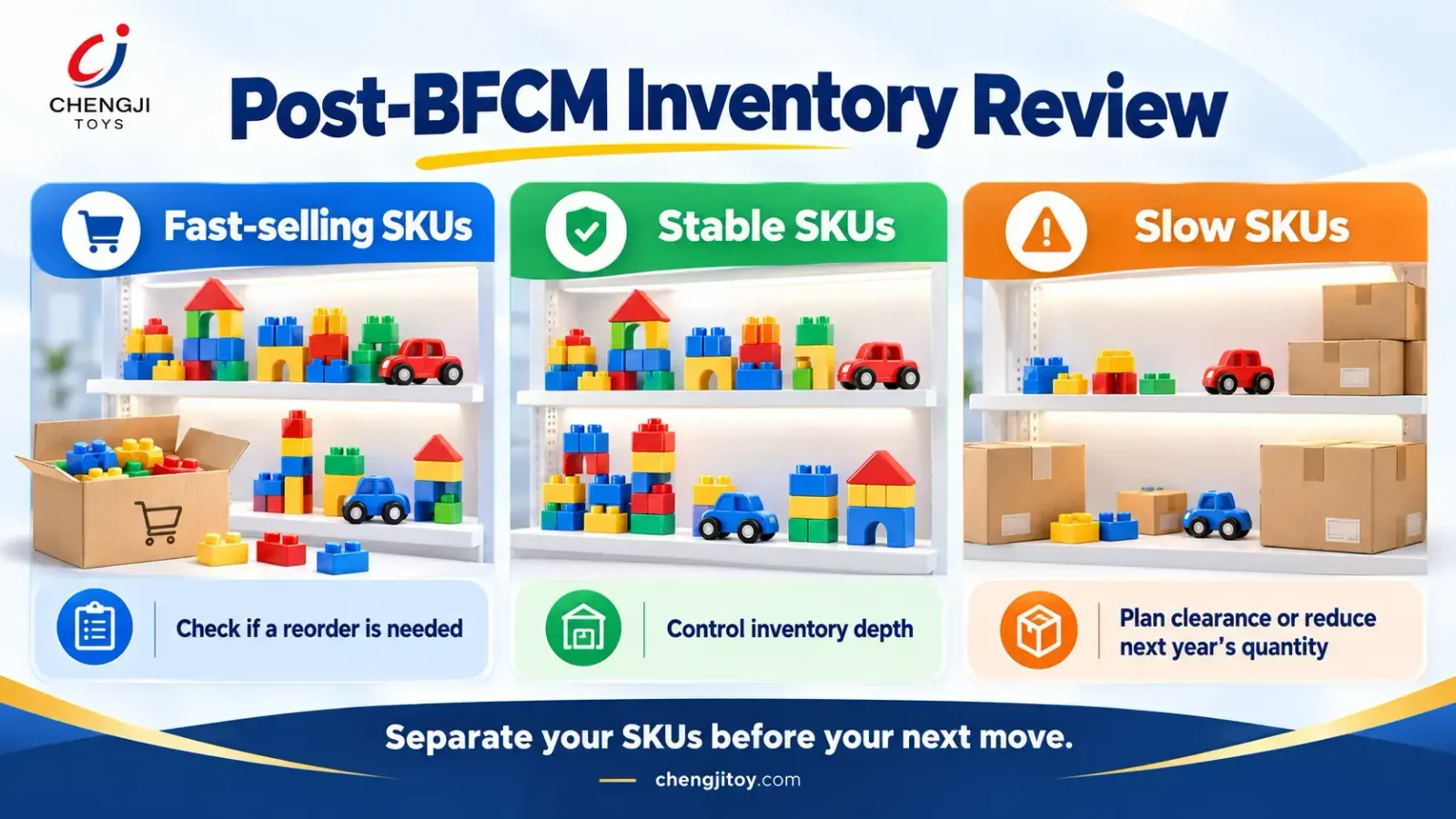
Then divide the range into three working groups.
| SKU group | What to examine | Purchasing action |
|---|---|---|
| Fast-selling | Remaining cover, margin after promotion and whether demand continues without the discount | Assess a targeted reorder against the remaining sales window |
| Stable | Normal sales pace, confirmed inbound stock and the amount likely to remain after Christmas | Keep replenishment proportionate and control inventory depth |
| Slow | Ageing stock, exposure, pricing, product fit and whether listing or availability problems affected sales | Plan a suitable clearance route for saleable stock, or reduce future quantities after identifying the cause |
Calculate cover using the next sales period
A simple starting point is:
Days of cover = usable, uncommitted stock ÷ forecast daily unit sales.
For example, 360 usable units at an expected 24 units per day provide 15 days of cover. This is an illustration, not a recommended stock level. The forecast should reflect the coming period, including the end of promotional pricing and any expected Christmas demand. Do not assume the fastest BFCM day represents every day in December.
Check inbound stock by its expected usable date. Goods on the water or waiting for warehouse receiving cannot cover an immediate gap. Equally, low recorded sales during a stockout do not necessarily mean weak demand.
Give Christmas top-ups a separate decision
A fast-selling SKU does not automatically justify another full production order. Compare the date you need saleable stock with the complete replenishment schedule: goods readiness, inspection, transport, customs and channel receiving.
In early December, ready stock already near the destination may offer a more practical Christmas top-up than a new custom order from China. Any express shipment still needs a confirmed route and cost assessment. Recalculate the margin after expedited freight, fulfilment charges and a reasonable after-sales allowance.
If the goods would miss the useful selling window, consider whether they have genuine post-holiday demand. Avoid turning a short-term shortage into next year’s excess inventory.
2. Prepare the After-Sales Plan Before the Full Return Picture Appears
The first days after Cyber Monday provide an early signal, not a final quality verdict. Some toys bought as gifts will not be opened until Christmas. Review the initial issues now, then revisit the same sales cohorts as customers receive and use the products.
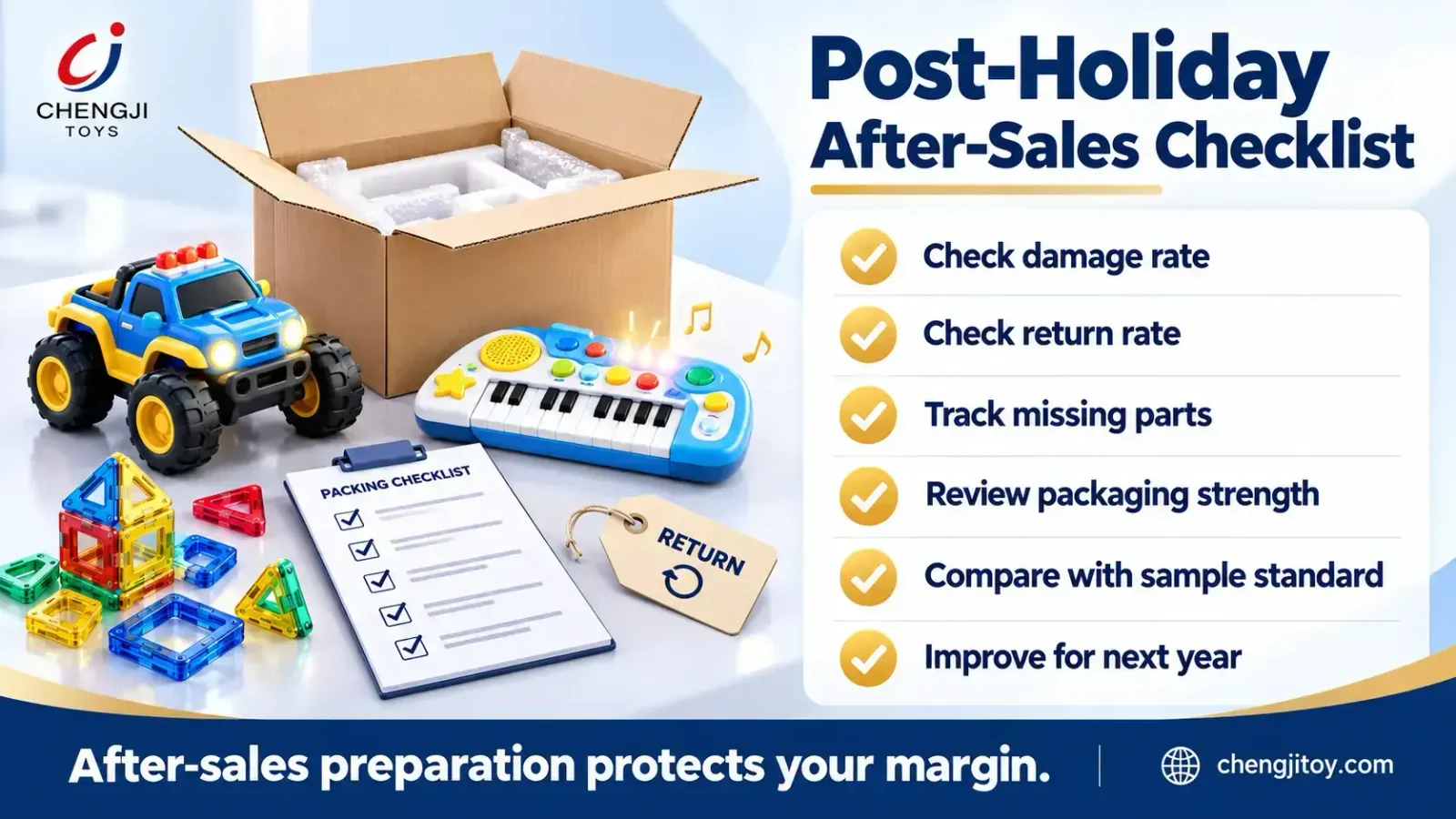
Keep product defects, transport damage, missing accessories, setup problems, and change-of-mind returns separate. A single overall return percentage cannot tell the sourcing team what to improve.
Build a useful issue record
For each complaint, record the SKU, batch or order reference, issue type, affected quantity, photos or video, and the proposed remedy. Where possible, connect the issue to its delivery or sales cohort.
When comparing return rates, use consistent unit-based definitions and allow similar time for returns to appear. An older batch with several weeks of customer use is not directly comparable with a batch delivered yesterday. Keep the observation date visible so the team understands how complete the data is.
For gift sets, check the presentation box, protective inserts and the stated contents. For sound-and-light toys, separate a product fault from battery setup or instruction-related questions. These are practical checks for those formats, not an assumption that either category has a higher defect rate.
Agree the response and the product correction
Before enquiries build up, confirm who handles each issue, what evidence is needed, and when replacement parts, a replacement unit or another agreed remedy is appropriate. Check the availability of suitable spare accessories rather than promising them before supply is confirmed.
Use recurring issues to update the next order: clearer instructions, a more secure accessory compartment, better protective packaging or a revised inspection point. Compare the proposed correction with the specification and retained sample, then approve any change before production. Where a change affects safety or compliance, include the relevant review before release.
Safety-related complaints should be escalated promptly through the product-safety process, separately from routine return handling. The objective is to resolve the immediate issue and prevent a repeat in the next batch.
3. Turn the Review into a Confirmed 2027 Sourcing Plan
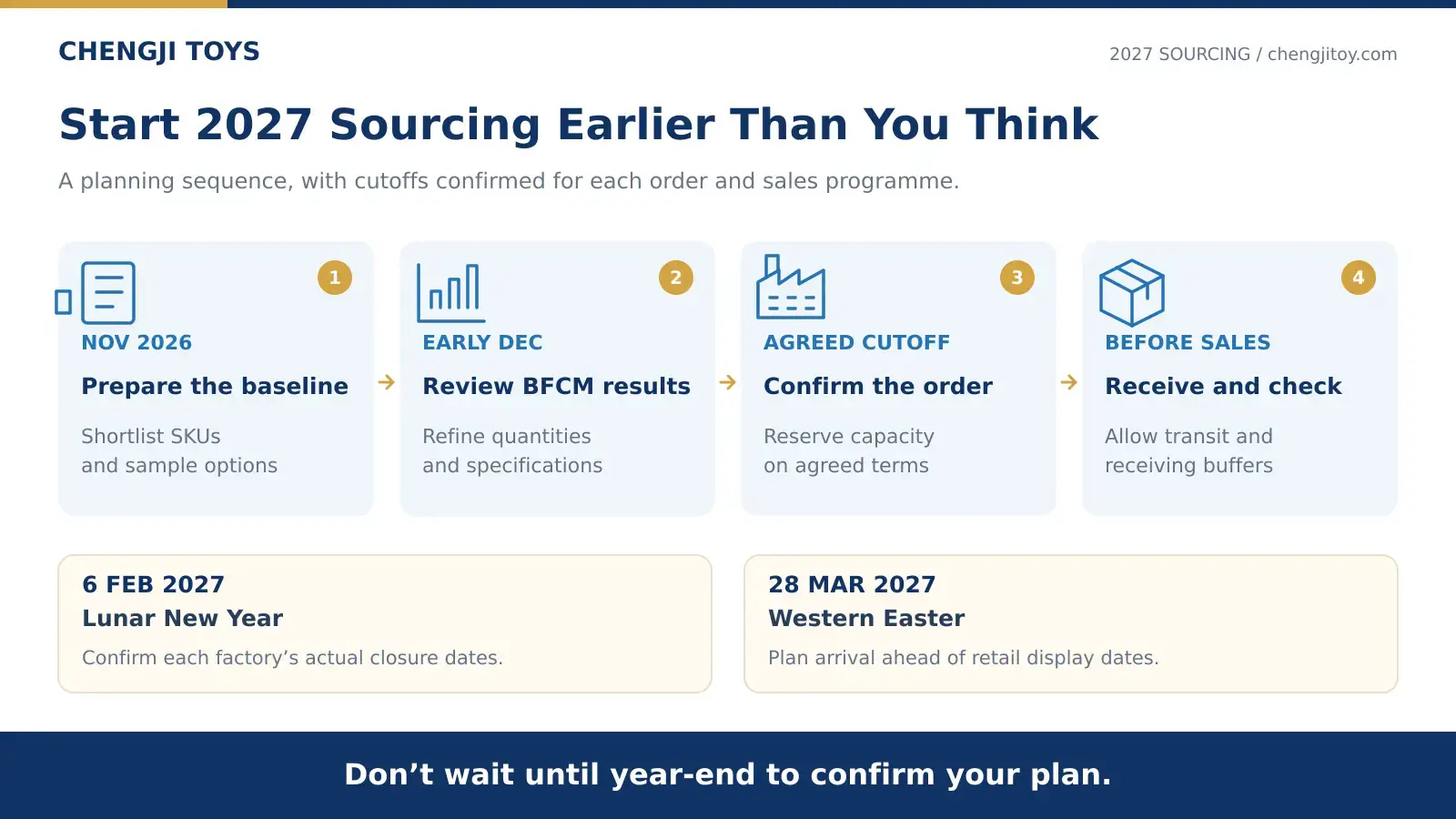
November is the preparation window: establish the sales baseline, shortlist products, discuss samples and ask about available capacity. Once BFCM is over, use the early-December results to refine that work. If preparation has not started, begin now rather than waiting for the last week of the year.
Here, 2027 planning means early-year replenishment and spring programmes, not a promise that a new order placed in December will arrive for January 1. Those are different deadlines and need separate feasibility checks.
Work backwards from the on-shelf date
Start with the retailer’s display date or the date an e-commerce SKU must be available to customers. Work back through receiving, local delivery, customs, international transport, inspection, production, and sample approval. Add contingency where the route or approval process is uncertain.
Two calendar points deserve attention:
- Lunar New Year falls on February 6, 2027. The date is listed in the Hong Kong Government’s 2027 holiday calendar. Confirm each supplier’s actual production stop, restart, and order cutoffs in writing; the holiday date alone does not define a factory’s closure period.
- Western Easter Sunday falls on March 28, 2027, as shown in the USCCB’s 2027 calendar. For retailers targeting that event, an April–June arrival would be too late. Stock must be ready for their earlier display and selling period. Other spring programmes follow their own dates.
Make the pre-order specific
An early discussion gives both sides more time to assess materials, packaging, samples and capacity. It does not, by itself, establish a fixed price or reserve a production slot.
Before relying on a pre-order, confirm the SKU and specification version, quantity, approved sample, packaging, target shipment schedule and any agreed batch releases. Record the price-validity period, payment requirements, scope of any material-price agreement, and the deadline for quantity or artwork changes.
A reservation should state what has actually been committed and when it expires. That clarity makes the arrangement useful for both purchasing and production.
Keep flexibility where the evidence is incomplete
The first December review will not contain every Christmas return. Use it to progress samples and the more predictable parts of the range while keeping unresolved product issues visible.
Where commercially feasible, discuss phased releases for stable sellers and smaller initial commitments for less certain items. Any flexibility needs agreed quantities, cutoffs and costs. It should not depend on an assumption that capacity or materials can remain available indefinitely.
Match the Plan to the Market and the Retail Programme
A broad region is not a purchasing forecast. Use the buyer’s actual channel, age group, price point and promotional calendar to decide which products deserve samples or a production commitment.
| Programme | Possible assortment discussion | Confirm before ordering |
|---|---|---|
| US and European retailers with an Easter gifting programme | Compact creative-play items, educational toys or giftable activity sets suited to the retailer’s range | Local event calendar, display date, pack size, age suitability and target landed cost |
| Middle Eastern retailers with a Ramadan or Eid gifting programme | Age-appropriate family-play or children’s gift-set combinations | Country-specific selling period, local language needs, destination requirements and delivery target |
| Year-round wholesale or e-commerce replenishment | Proven evergreen SKUs, with seasonal items managed separately | Post-promotion demand, stock cover, receiving lead time and reorder economics |
These are starting points for a buyer discussion, not claims that every market will buy the same range. Validate the assortment against local sales evidence before committing to larger quantities.
How Chengji Connects the Review to the Next Order
Chengji can help turn the information you already have into a clearer sourcing brief:
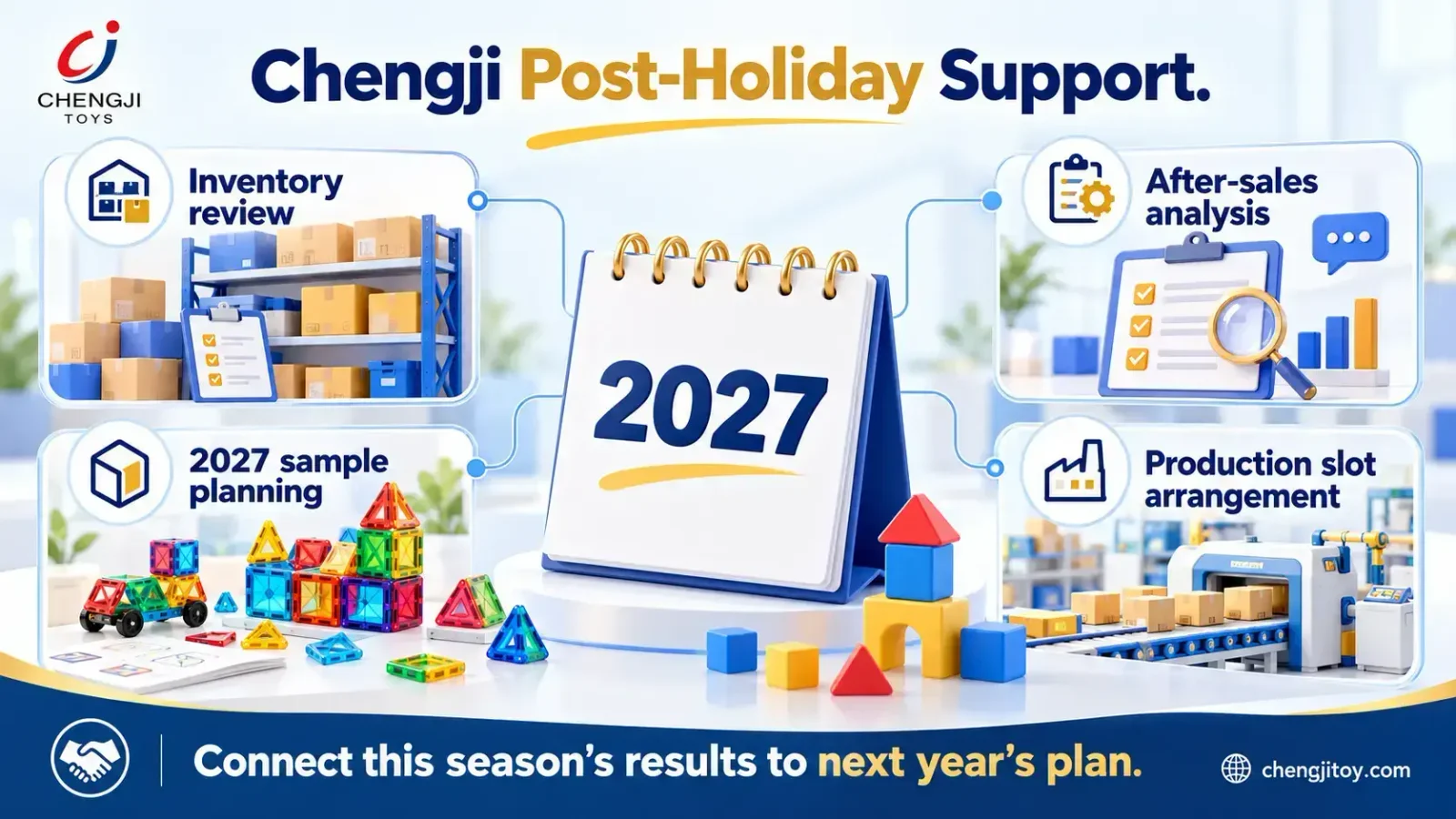
- Inventory review: discuss SKU priorities using your sales, stock and delivery targets, then identify practical replenishment or sample options.
- After-sales analysis: review issue records, photos, and packaging or accessory details with the relevant production team.
- 2027 sample planning: prepare suitable new-item suggestions, samples and gift-set proposals for your market and budget.
- Production slot arrangement: discuss pre-orders and phased supply, with capacity, material pricing, and reservation conditions confirmed for the specific order.
For confirmed products, Chengji can provide specification sheets and retain approved samples. Materials, accessory counts, packaging, and agreed inspection points give the next order a clear reference. Any later change should be approved and recorded before it reaches bulk production.
Request a 2027 Toy Shortlist and Sample Plan
Send Chengji your target market, sales channel, age range, priority categories, estimated quantity and required on-shelf date. If you already have a range, include the SKUs you want to replenish and the main issues you want the next order to improve.
We can help prepare a relevant 2027 product shortlist, discuss samples and specifications, and assess a feasible pre-order plan. Use this season’s results to make the next sourcing decision more precise.
Website: chengjitoy.com
Email: [email protected]
Phone / WhatsApp / WeChat: +86-13715966567