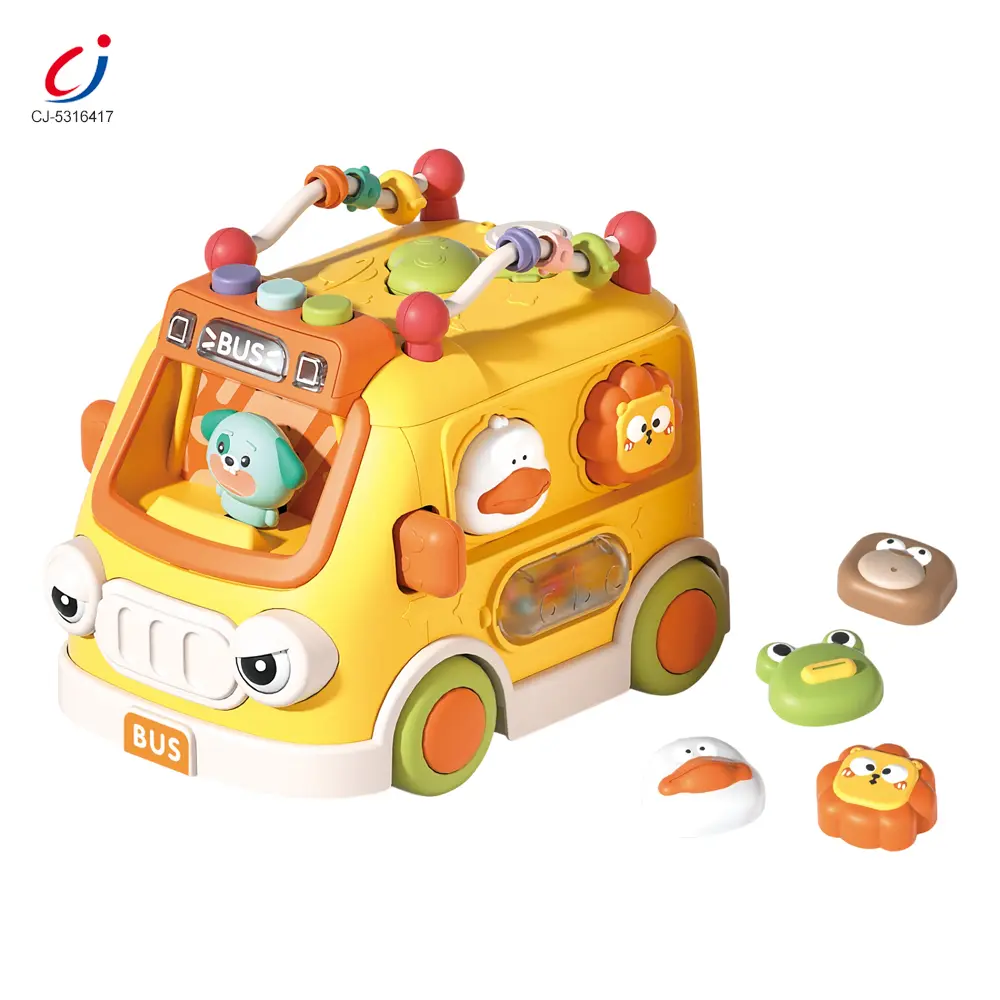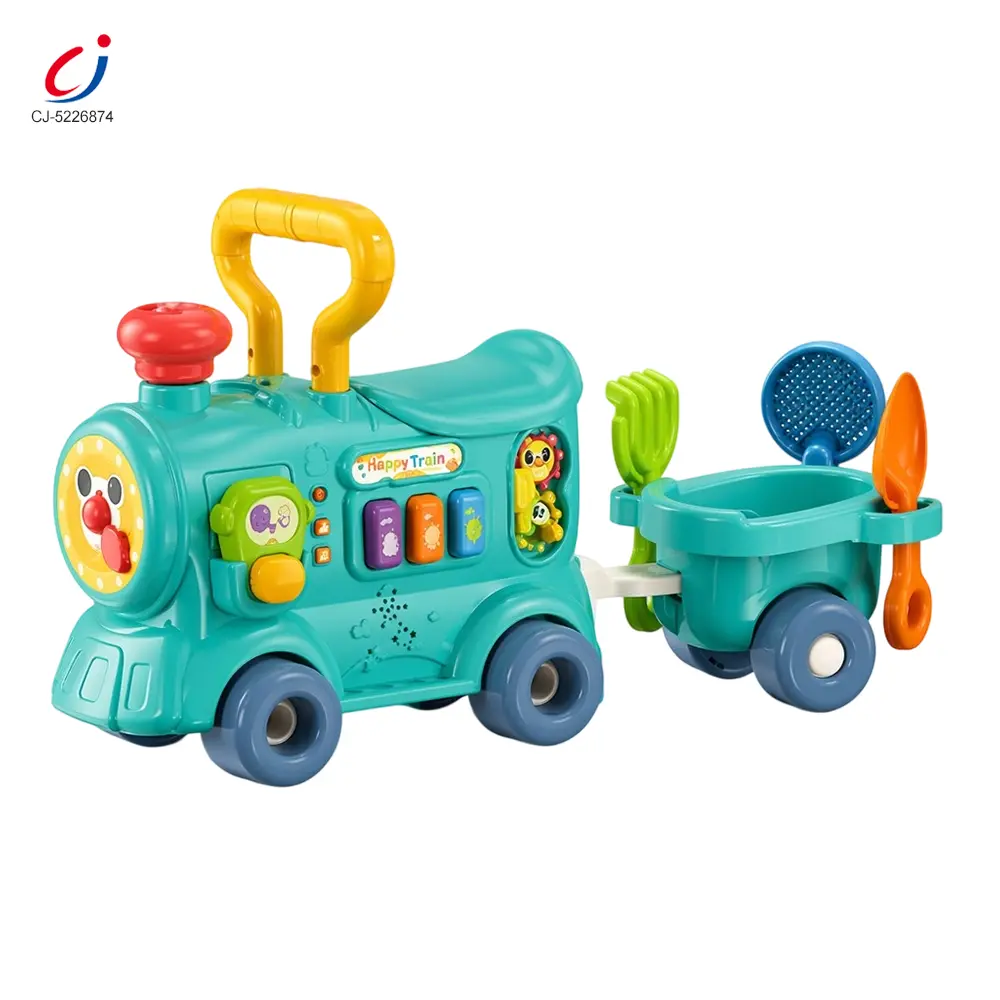

“Another supplier quoted 20% less. The products look the same. Why is your price higher?”
For toy importers, wholesalers and retailers, this is a reasonable question. When two product photos show the same shape, color, and apparent features, the lower quotation deserves consideration.
The difficulty is knowing whether those prices cover the same product specification. A water blaster may have a thinner shell. A play set may include fewer accessories. A gift box may use a different board grade. These differences can be difficult to spot in a catalog image, yet become expensive once the goods reach your warehouse or customers.
An unchanged price can hide the same problem. If a repeat order costs the same per unit but arrives with less material, fewer components or weaker packaging than agreed, the buyer receives less value for the same payment. That is the “hidden price increase” this article examines.
A lower price is worth comparing. An unexplained difference in specifications is worth investigating.
At Chengji Toys, our sourcing principle is straightforward: make the specification clear, explain the trade-offs, and do not substitute a lower specification without the buyer’s approval. Here are the three areas buyers should examine before deciding that two quotations are equivalent.
1. Materials: The Same Shape Can Hide a Different Specification
A product photo rarely tells you the resin grade, wall thickness, or material formulation. Two similar-looking toys can therefore differ in weight, rigidity, surface finish and performance during use.
For example, reducing the wall thickness around a water blaster’s handle or screw points may reduce material consumption. Whether the revised design still performs adequately depends on its construction and the relevant tests. A similar appearance alone cannot answer that question.
Look beyond “virgin” and “recycled” labels

Virgin ABS and recycled plastics should not be treated as automatic pass-or-fail categories. Recycled content does not, by itself, prove that a toy is poor quality. Virgin material does not, by itself, prove that the finished toy is safe or durable.
What matters is the specified material, its consistency, the product design, and evidence that the finished product meets the agreed performance and applicable safety requirements. Likewise, a description such as “food-grade silicone” should not replace product-specific checks for a teether or baby toy.
Weight, unusual odor, discoloration or unexpected flexibility can prompt further questions. They cannot reliably identify a resin formulation or confirm chemical safety.
Before approving the quotation, ask for:
- The material specification for the main body and other critical components.
- Any agreed restrictions on recycled content or material substitutions.
- Product dimensions, target weight, and acceptable tolerances where relevant.
- Functional and durability checks suited to the toy’s intended use.
- Relevant testing documentation for the specific product and destination market.
For the U.S. market, the CPSC explains that the applicable toy safety requirements depend on the product. Its guidance covers matters including chemical limits, small parts, and accessible edges; a general material description is not a complete compliance assessment. See the CPSC Toy Safety Business Guidance.
The commercial risk is straightforward: a saving on material can become a buyer’s expense if the delivered specification causes breakage, rework, or complaints. The aim is to verify the agreed performance before shipment.
2. Accessories and Packaging: What Exactly Does “One Set” Include?
“Water play set” or “gift box packaging” is not a complete specification.
One quotation may cover only the main toy. Another may include a storage bag, spare connector, and instruction leaflet. Both can be legitimate offers, but they are different purchasing options. The comparison becomes misleading when those differences are left unclear—or when approved components disappear from bulk production.
Ask for an itemized list showing the component name, quantity, and specification for every included item. Confirm whether batteries, charging cables or other operating accessories are included when relevant. Required instructions and warnings must also be addressed for the product and market.
Specify the packaging as carefully as the toy
A gift box described only by its dimensions or artwork can still vary in construction. As an illustrative example, changing from 350 g/m² to 250 g/m² paperboard changes an agreed packaging specification even if the artwork stays identical.
Board weight alone does not determine packaging strength. Board type, thickness, inserts, box structure and the export carton also matter. Buyers should assess the complete packing system against the expected handling and transport conditions.
| Area to compare | What to put in writing | What to check before shipment |
|---|---|---|
| Main product | Model, configuration and quantity per set | Correct version and count |
| Accessories | Itemized list, quantities and key specifications | Every agreed component is present and suitable |
| Instructions and labels | Approved artwork, language and required information | Correct revision included or applied |
| Retail packaging | Board type and weight, dimensions, inserts and printing | Construction matches the approved specification |
| Export packing | Carton specification, packing quantity and protective arrangement | Actual cartons and packing match the order |

A simplified set may be the right choice for a price-sensitive channel. It should be offered as a clearly identified option, with a matching sample and quotation. It should never quietly replace the version the buyer approved.
3. Shape and Finishing Details: Similar at a Distance, Different Up Close
Small manufacturing details can affect how a toy feels, functions, and presents on a retail shelf.
Raised molding seams, uneven gaps, excess plastic at an edge, blurred printing, or poorly aligned graphics may be difficult to see in a small product photo. These issues can arise from tooling condition, molding settings, assembly, printing or inadequate inspection. They should not automatically be attributed to mold cost alone.
For gift retailers and stores where shoppers handle products, visible finish contributes to perceived value. Functional details matter just as much: a connector that does not fit, a lid that does not close, or a mechanism that sticks can undermine the buying experience.
Separate cosmetic standards from safety requirements
A small color variation and a hazardous sharp edge are not the same kind of issue. Define acceptable cosmetic variation, but assess potential safety defects against the applicable requirements. A budget product still needs to meet the safety requirements for its intended market.
When evaluating samples, examine:
- Molding seams, accessible edges and excess plastic.
- Part alignment, gaps and the fit of moving or connecting components.
- Print clarity, position, color consistency and resistance to wear where relevant.
- Operation under the agreed functional checks.
- Whether the presentation suits the intended retail or gift channel.
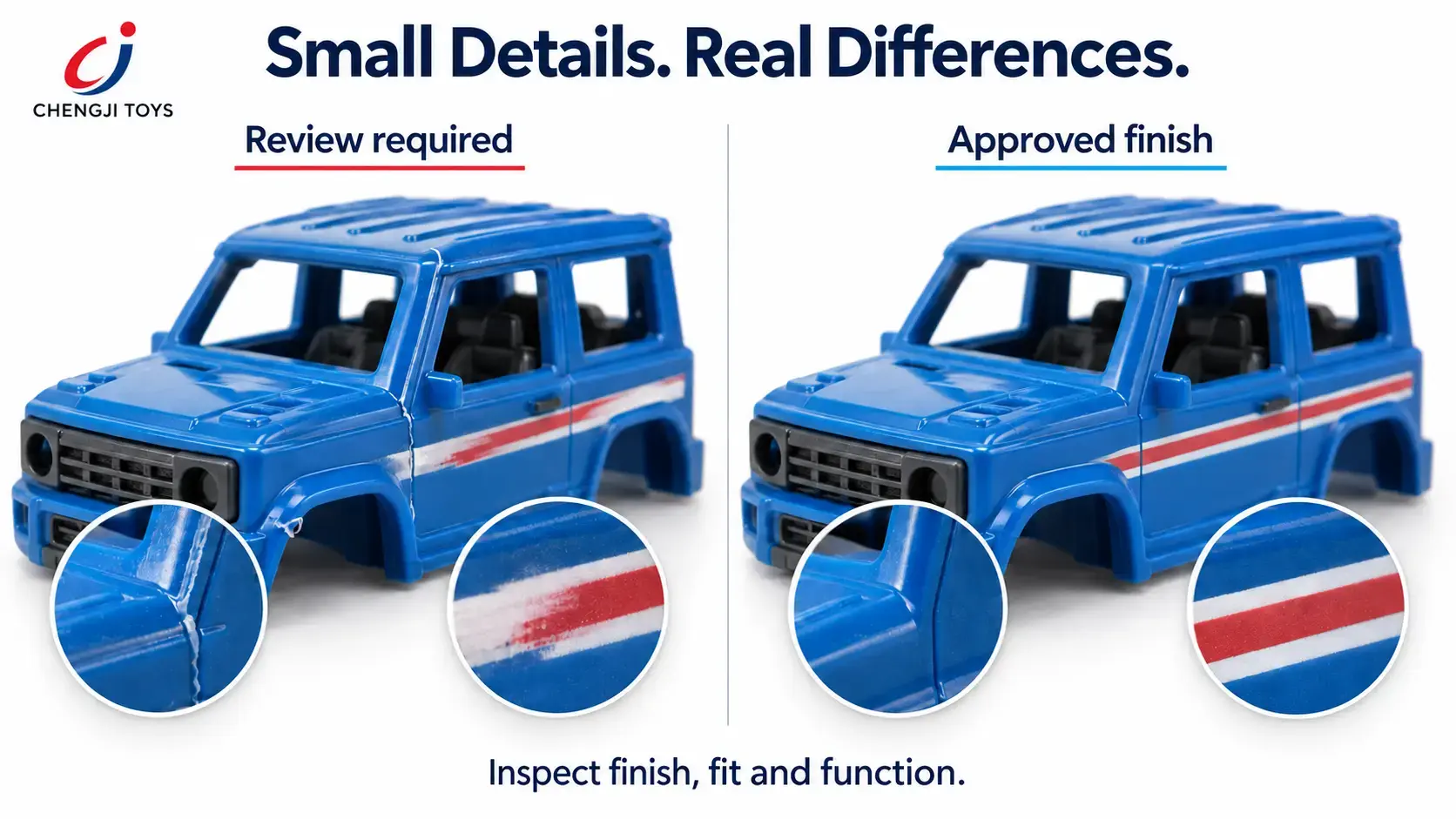
Use close-up photographs and an approved physical sample to document the expected finish. Where a specification cannot be communicated clearly in words, agree on visual examples of acceptable and unacceptable results.
4. Three Actions That Make Quotation Comparisons More Reliable
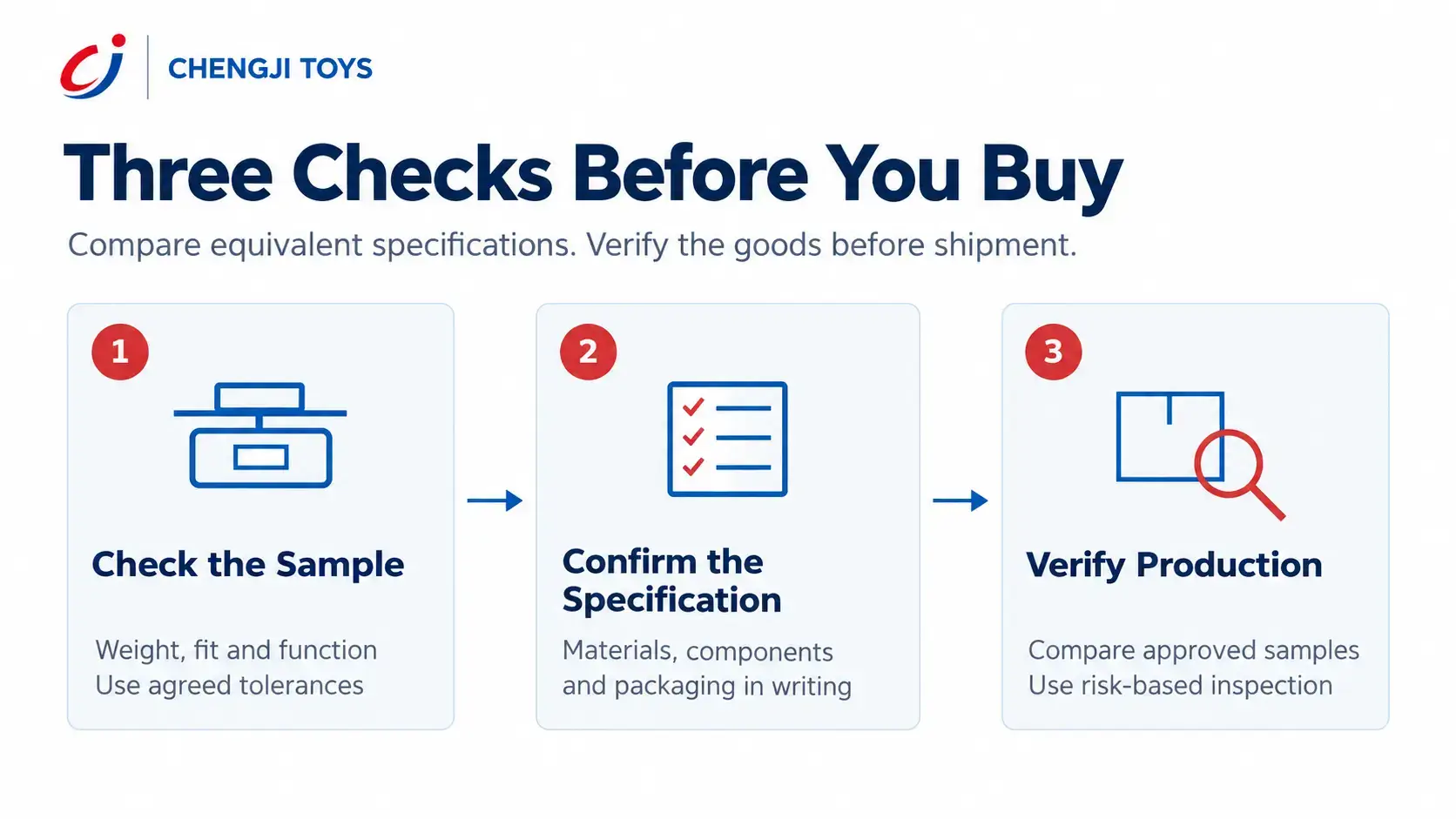
Step 1: Measure and inspect samples against an agreed baseline
Record the sample’s weight, dimensions, included components, and key functional observations. Compare equivalent configurations under the same conditions—for example, with the same accessories and without packaging unless packaging weight is being checked.
Unexpected differences deserve an explanation. There is no universal rule that a weight difference above 5% proves material substitution. Set relevant tolerances for the particular product, and investigate deviations against those limits.
Use hands-on inspection to identify questions for the supplier. Use appropriate testing when a safety or performance question requires more than a visual or tactile check.
Step 2: Make both suppliers quote the same written specification
Request quotations against a common specification sheet covering materials, configuration, accessories, packaging, and required checks. Align the commercial basis too: order quantity, delivery terms, payment terms and any separately charged testing or packaging costs.
Ask one direct question: “What is different between this quotation and the approved specification?”
If a supplier proposes a cost-saving alternative, ask for the change and its price impact separately. Attach the accepted specification and sample reference to the order, and require written approval before substitutions.
Step 3: Compare production with the approved sample before shipment
Keep a dated, identifiable approved reference sample and ensure the supplier has the same reference. During production and before shipment, check actual goods against that sample, the component list, and the written specification.
Retaining two or three units can help with later traceability, but those units alone do not establish that an entire shipment is consistent. The inspection scope and sample size should reflect the lot, product risks, and agreed acceptance criteria.
Resolve discrepancies before shipment release. Keep the inspection records and any approved changes with the order so the next repeat purchase starts from a clear baseline.
Compare the Saving with the Cost You May Have to Absorb
Consider a hypothetical quotation of $4.00 instead of $5.00 per set. That is a 20% reduction and, across 1,000 sets, a $1,000 purchase-price saving.
The next question is whether both offers include the same specification. If the cheaper option requires extra accessories, repacking, inspection, or replacement of unsellable units, those costs reduce the initial saving. The size of that effect depends on the actual order; a lower quote does not automatically become the more expensive choice.
A useful comparison is:
Effective cost per saleable set = total attributable procurement and corrective costs ÷ saleable sets.
Use the same cost basis for both offers and avoid counting the same expense twice. Also consider consequences that are harder to price immediately, such as missed launch dates or retailer complaints.
Chengji Toys’ Approach: Transparent Specs, Consistent Quality
At Chengji Toys, we believe buyers should understand what a quotation includes and what any proposed price reduction changes.
Our supply principle is to document the agreed materials, accessories, and packaging, and use the confirmed specification and approved sample as the reference for bulk production. Cost-saving changes should be discussed openly and approved before implementation.
That means no unapproved material downgrades, omitted accessories, or reduced finishing specifications to preserve a quoted price. If a different configuration better suits your budget, the difference should be visible before you place the order.
Comparing toy supplier quotations? Send Chengji Toys your product reference, target market, required accessories, packaging requirements, and expected quantity. We can help clarify the specifications, provide a detailed quotation, and discuss samples so you can compare your options with confidence.
Website: chengjitoy.com
Email: [email protected]
Phone / WhatsApp / WeChat: +86-13715966567