Importing toys from China to Mexico involves more than choosing products, placing an order, and arranging transportation. First-time importers need to coordinate the product itself, Mexican import requirements, tariff classification, labeling, documentation, and customs clearance before the goods enter the Mexican market.
The most practical way to approach the process is to work backward from the product you intend to sell: define the toy → confirm its classification → identify applicable requirements → prepare labeling and documents → coordinate production and shipment → complete customs clearance.
This guide explains the process from a beginner’s perspective and shows where a China-based toy sourcing partner can support the supplier-side work.
What Should You Prepare Before Importing Toys from China to Mexico?
Before contacting a supplier, a Mexican buyer should establish whether the business and product are ready for import.
Confirm Your Importer Status in Mexico
Businesses and individuals intending to import merchandise into Mexico generally need to be registered with the Padrón de Importadores. SAT currently requires, among other conditions, an active RFC, a valid e.firma, compliance with tax obligations, a fiscal address that is located or under validation, and a validated Buzón Tributario. SAT also requires the importer to have an authorized customs agent, customs attorney, or legal representative handling foreign-trade operations.
This is an importer-side responsibility. A Chinese toy supplier does not replace the Mexican importer or its customs representative.
Define the Toy You Plan to Import
The exact product matters because “toy” is too broad to determine every applicable requirement.
Before ordering, document:
- Product type and function
- Main materials
- Intended age group
- Whether it uses batteries or another power source
- Components and accessories
- Packaging configuration
- Product quantity
- Intended sales channel
For example, a simple plastic construction toy and a battery-operated electronic toy may require different technical and regulatory considerations.
Confirm the Product’s Tariff Classification
The next step is to determine the applicable fracción arancelaria before calculating the total import cost.
Tariff classification can affect the customs declaration, applicable duties, and non-tariff regulations. VUCEM’s customs terminology identifies the pedimento as containing information including the merchandise, origin, value, tariff classification, customs entry, and compliance with applicable regulations.
For this reason, importers should not assume that every toy imported from China has the same tariff rate or regulatory checklist. The specific product should be classified with the support of the appropriate Mexican customs professional.


What Mexico Toy Import Regulations Should You Check?
Once the product has been clearly defined, the next step is to determine which Mexican requirements apply.
NOM-015-SCFI-2007 for Toy Labeling
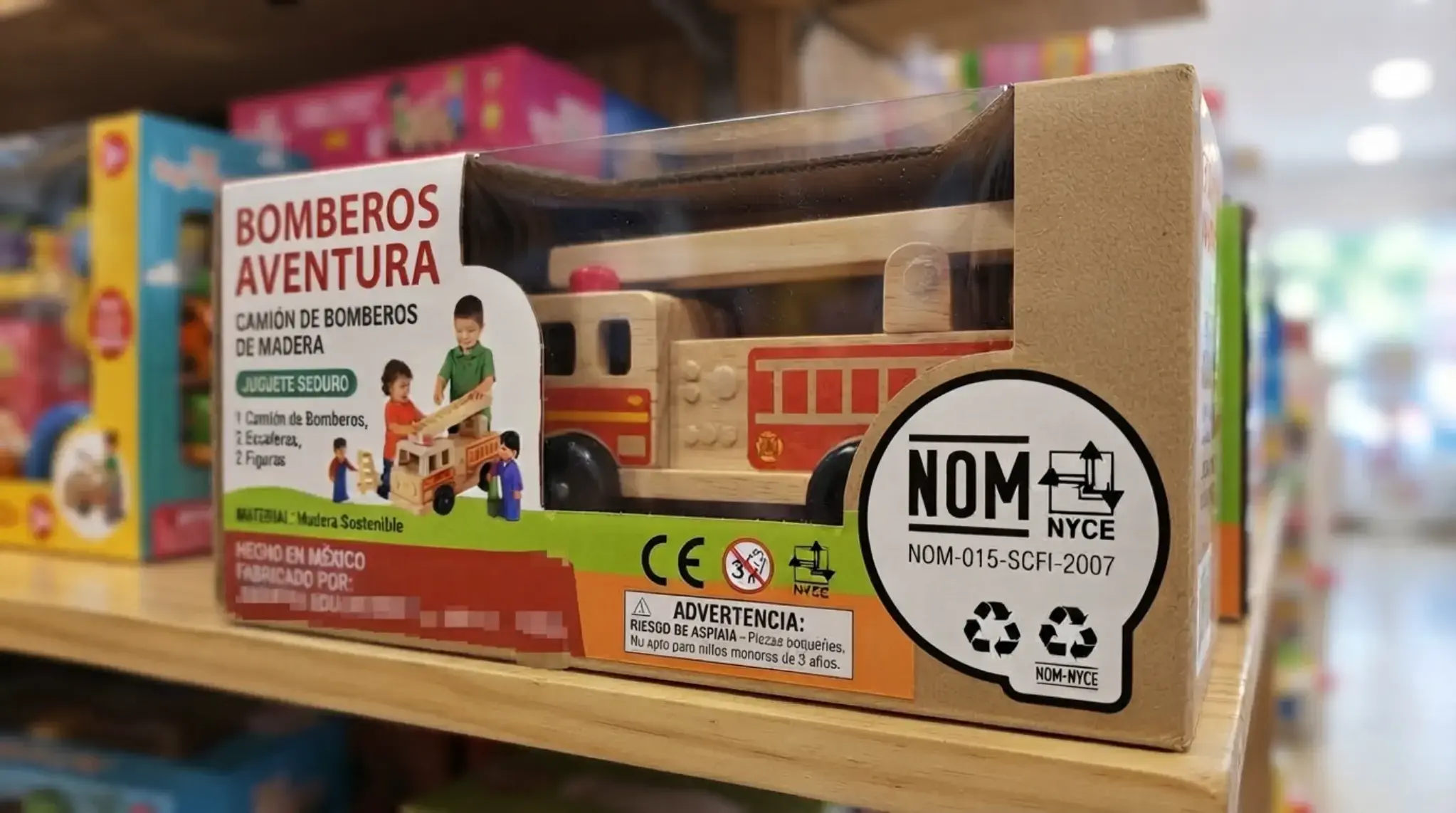
One of the key standards for toys marketed in Mexico is NOM-015-SCFI-2007, Información comercial–Etiquetado para juguetes.
Mexico’s Ministry of Economy currently lists NOM-015-SCFI-2007 as vigente. The standard establishes commercial information requirements for toys marketed in Mexico and applies to toys made from any material, including toys operated by batteries or other power sources. It also specifically covers the person or company that acquires domestic or imported toys for distribution or sale in Mexico.
Other Requirements Depend on the Toy
NOM-015 should not be treated as a universal compliance checklist for every possible toy-related import requirement.
Additional considerations can depend on characteristics such as:
- Electrical functions
- Batteries or other power sources
- Product construction
- Intended use
- Components
- Tariff classification
This is why the compliance process should begin with the actual product rather than with a generic list of “toy regulations.”
Why Classification Should Come Before a Compliance Checklist
A useful way for first-time importers to think about the process is:
Product characteristics → tariff classification → applicable regulations → labeling and documentation
This sequence reduces the risk of preparing the wrong documents or packaging information based on an assumption about the product.
The importer should also work with a Mexican customs professional when determining classification and the requirements applicable to a specific shipment.
What Are the Toy Labeling Requirements in Mexico?
Labeling is one of the areas that should be addressed before production rather than after the toys have arrived in Mexico.
What Information Does NOM-015-SCFI-2007 Require?
Under NOM-015-SCFI-2007, mandatory commercial information can include:
- The generic name of the product when it is not readily identifiable
- Quantity, where applicable
- Manufacturer or responsible-party information under the conditions specified by the standard
- Country of origin
- Importer’s name or company name and fiscal address for imported products
- The manufacturer’s recommended consumer age indication
- Battery or power-source information where applicable
- Nominal electrical information for toys operating above the specified voltage threshold
The standard contains specific conditions and exceptions for some of these requirements, so the packaging should be checked against the applicable provisions rather than copied from another toy product.
For imported products, the standard also allows certain importer information to be incorporated in Mexico after customs clearance and before commercialization.
Do Toy Labels Need to Be in Spanish?
Mandatory information on toy labels must be presented in Spanish, although additional languages can also be used. The information must remain available to the consumer until purchase and must be presented in a sufficiently legible form.
This makes packaging preparation an important part of the import process. If a Chinese supplier produces packaging only for another market, the Mexican importer may need to adapt the packaging or labeling before the products can be commercially distributed.
What About Instructions and Warnings?
NOM-015 also addresses instructions, warnings, and specific product situations.
Toys intended to be assembled must include assembly instructions or a written/graphic explanation. The standard also establishes requirements for instructions and safety warnings, including provisions concerning small parts and toys intended for younger children.
The exact warning requirements depend on the characteristics of the toy. Therefore, an importer should identify the applicable provisions during product development instead of adding generic warnings to every product.
What Documents Are Needed to Import Toys from China?
The exact documentation package depends on the product and import operation, but a first-time importer should expect to coordinate several categories of information.
Import and Customs Documentation
Typical commercial and logistics documentation can include:
- Commercial invoice
- Packing list
- Transport documents
- Customs declaration or pedimento
- Product information needed for classification
- Supporting information for applicable regulatory requirements
The pedimento is particularly important because it records key information about the imported merchandise, including its classification, origin, value, and applicable regulatory compliance.
Product Compliance and Supporting Documents
Depending on the toy, the importer may also need supporting product information such as:
- Product specifications
- Packaging and label information
- Instructions
- Test reports where applicable
- Battery or electrical information
- Other documents associated with applicable regulations
The important point is that there is no single test-report package that can simply be applied to every toy. The required evidence should be determined from the product’s characteristics and applicable Mexican requirements.
How to Import Toys from China to Mexico Step by Step
For a first-time buyer, the entire process can be simplified into six major stages.
Step 1 — Select and Define the Product
Start with the actual product rather than the supplier.
Confirm its specifications, materials, functions, intended age, packaging, quantity, and target market.
If you are considering several products, document these characteristics separately because different products may have different classification and compliance requirements.
Step 2 — Confirm Classification and Applicable Requirements
Before production, determine the relevant tariff classification and identify the regulations associated with that classification and product.
This is where the importer should involve the appropriate Mexican customs professional. Do not rely only on a supplier’s suggested HS code when making the final Mexican import determination.
The objective is to establish:
What is the product? → How is it classified? → What requirements apply?
Step 3 — Confirm the Chinese Supplier’s Product Information
Once you know what you want to import, the supplier needs to provide accurate product information.
This can include:
- Product specifications
- Materials
- Product dimensions
- Packaging configuration
- Carton information
- Quantity per carton
- Product photos or samples
- Available supporting test or compliance documents
Accurate information at this stage helps the importer and customs professional make decisions based on the actual product rather than assumptions.
Step 4 — Finalize Labeling and Packaging Before Production
If the product will be sold in Mexico, review the required labeling information before mass production.
This is especially important for private-label products. Changes to artwork, packaging, labels, instructions, or warnings are much easier to make before production than after finished goods have been manufactured.
The supplier should receive the approved packaging and product specifications as part of the production requirements.
Step 5 — Arrange Shipment and Customs Clearance
After production, the goods can be prepared for export from China and shipped to Mexico.
The general flow is:
Factory → Export shipment → Mexico arrival → Customs declaration → Customs clearance → Release
The Mexican importer and its customs professional remain responsible for the Mexican import operation. The Chinese supplier’s role is primarily to provide accurate product and shipping information and prepare the goods and export documents according to the agreed transaction.
Step 6 — Receive and Distribute the Toys in Mexico
After the shipment has completed the applicable customs procedures, the importer can move the goods into its domestic distribution or sales network.
At this point, the product should already have been prepared for the Mexican market rather than being treated as a generic China-market product that only needs to be shipped internationally.

How Can a China Toy Supplier Help With the Import Process?
A supplier cannot take over the Mexican importer’s legal responsibilities, but it can significantly reduce the complexity on the China side by helping with product sourcing, factory coordination, customization, and supplier-side information.
Help You Find Suitable Toy Products and Factories
For a first-time buyer, one challenge is finding a factory that can produce the right product rather than simply finding a factory that sells toys.
Chengji provides toy sourcing and wholesale services, with access to more than 2 million toy styles and 30,000+ cooperative factories, helping buyers compare products and production sources more efficiently. Samples are also available before bulk orders, allowing buyers to evaluate products before committing to larger quantities.
Coordinate OEM/ODM Requirements
For brands that need more than an existing catalog product, Chengji provides OEM and ODM toy solutions for international brands, wholesalers, online sellers, and chain retailers.
Chengji can coordinate with factories on product specifications, colors, packaging, branding, and other customization requirements. These details should be confirmed before production so that the finished products and supporting information are consistent with the import plan.
Keep Supplier-Side Information Organized
A sourcing partner can also help coordinate communication between the buyer and factory around:
- Product specifications and samples
- Packaging and customization
- Production details and quality control
- Available supporting documents
- Shipment information
Chengji’s OEM/ODM process covers details such as dimensions, materials, colors, logo placement, production capacity, quality control, and available test reports. This helps buyers keep China-side information organized, while the Mexican importer remains responsible for local compliance and customs procedures.
Conclusion: Prepare the Import Before the Shipment
Importing toys from China to Mexico is easier to manage when the compliance process starts before production rather than when the shipment reaches customs.
For a first-time importer, the essential sequence is straightforward: define the product, confirm its classification, identify the applicable Mexican requirements, prepare labeling and documents, finalize production, and then arrange shipment and customs clearance.
A China-based toy sourcing partner can support the supplier-side work by helping identify products and factories, coordinate samples and customization, and organize product information. Chengji provides these sourcing, wholesale, OEM, and ODM services, while Mexican importers should continue to work with the appropriate local customs and regulatory professionals for their specific import operation.