Many buyers entering toy customization for the first time confuse OEM و ODM. On the surface, both involve working with a factory to develop products. But in practice, the difference affects cost, development time, customization flexibility, and even IP ownership.
If you choose the wrong model too early, you may end up with unnecessary mold costs, a longer launch timeline, or a product that does not match your business goals.
This article breaks down the real difference between OEM و ODM in a simple and practical way, so you can decide which cooperation model is the better fit for your sourcing plan.
1. What Is the Real Difference Between OEM and ODM?
Although the two terms are often used together, their starting point is very different.
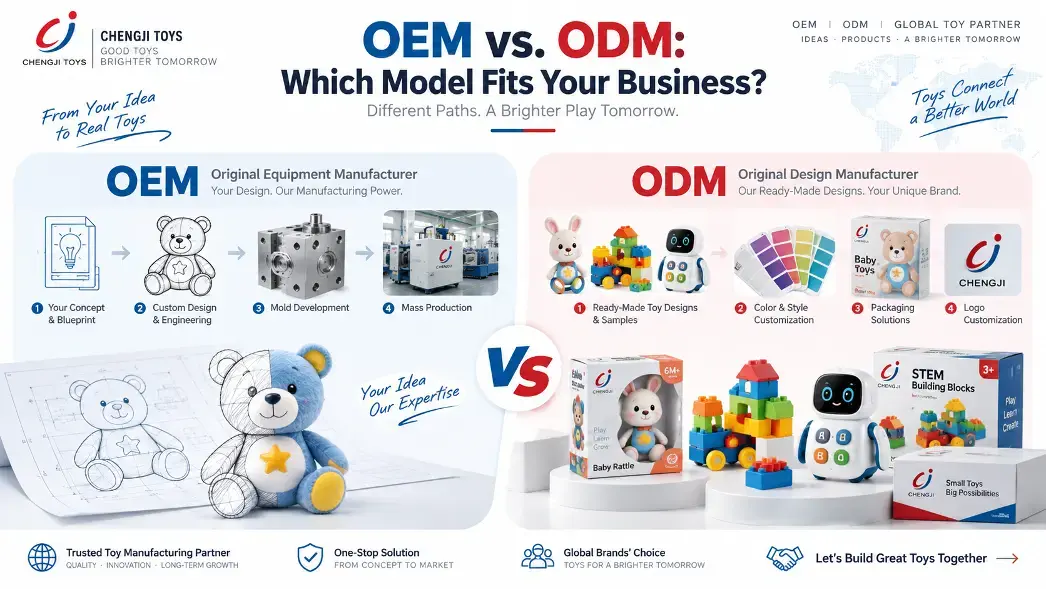
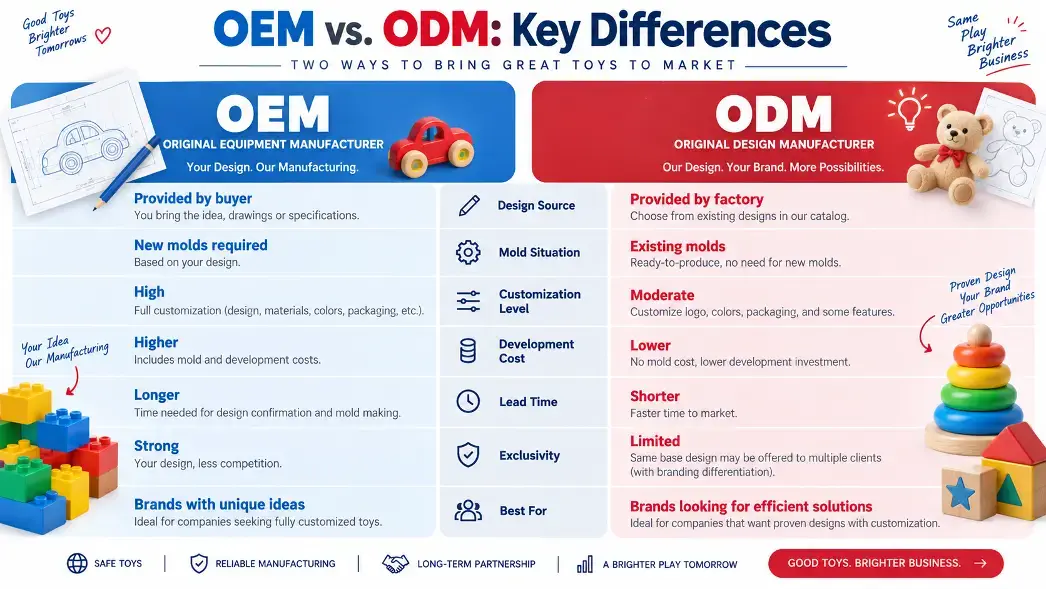
OEM: You provide the product idea, and the factory produces it
OEM stands for Original Equipment Manufacturing. In this model, the buyer usually provides the product concept, drawings, structure requirements, function requirements, branding details, or packaging direction, and the factory manufactures according to those specifications.
This means the buyer has more control over product design and can build a more exclusive product line.
OEM is usually suitable when:
- you already have a clear product concept or technical requirement
- you want a product that looks or functions differently from standard market items
- you care about brand uniqueness and product differentiation
- you are prepared for a longer development timeline
ODM: The factory already has the product, and you customize based on it
ODM stands for Original Design Manufacturing. In this model, the factory already has ready-made product designs, molds, and production experience. The buyer selects from existing options and usually customizes details such as:
- color
- logo
- packaging
- print design
- small functional adjustments
ODM is usually suitable when:
- you want to launch faster
- you do not have your own design team
- you want to reduce development cost
- you want to test the market with lower risk
In simple terms
- OEM = build from your idea
- ODM = customize from the factory’s idea
2. When Should You Choose OEM?
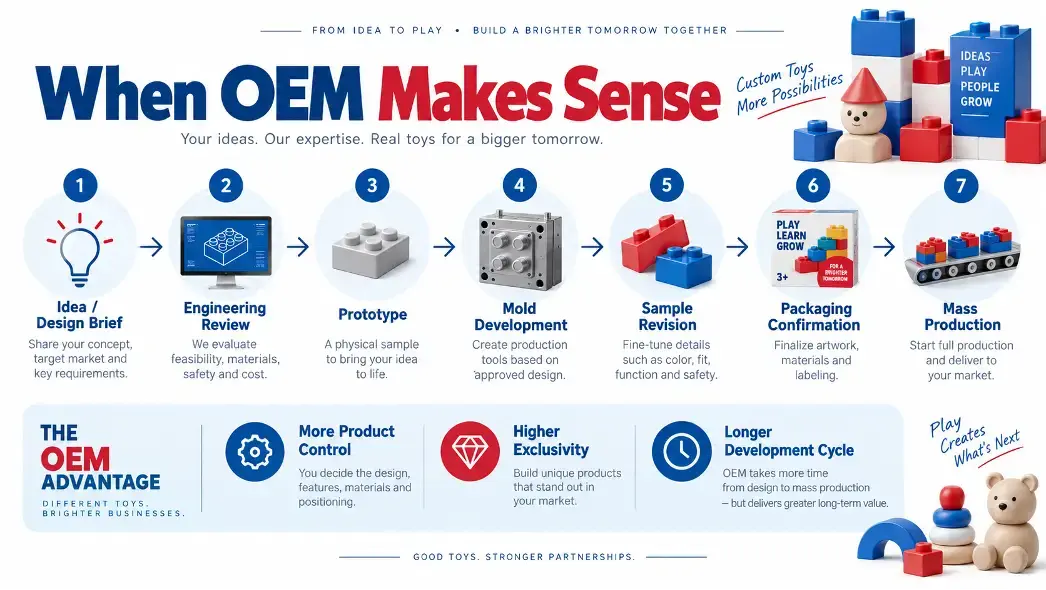
OEM is a better option when your goal is not just to source a product, but to build a distinct product line.
If you already have a clear idea of what you want — whether that is product appearance, structure, functions, packaging concept, or a completely new toy idea — OEM allows you to turn that concept into a real product.
This model is especially useful if you want to:
- develop a product that is not easily copied by competitors
- create stronger brand identity
- control detailed product specifications
- establish longer-term product barriers in your market
However, OEM also requires more preparation and investment.
What buyers should expect with OEM
Compared with ODM, OEM often involves:
- mold development cost
- sampling and revision rounds
- longer communication cycles
- longer production lead time
- clearer confirmation of ownership and responsibility
That is why OEM is often a better fit for:
- established importers
- brand owners
- retailers with long-term private-label plans
- buyers with stable order volume expectations
A practical example
If a buyer wants a toy with a new structure, custom function, or exclusive appearance, and does not want similar products widely sold in the market, OEM is usually the right path.
Best fit for OEM
Choose OEM if your priority is:
- exclusivity
- stronger brand positioning
- full product control
- long-term market differentiation
3. When Should You Choose ODM?
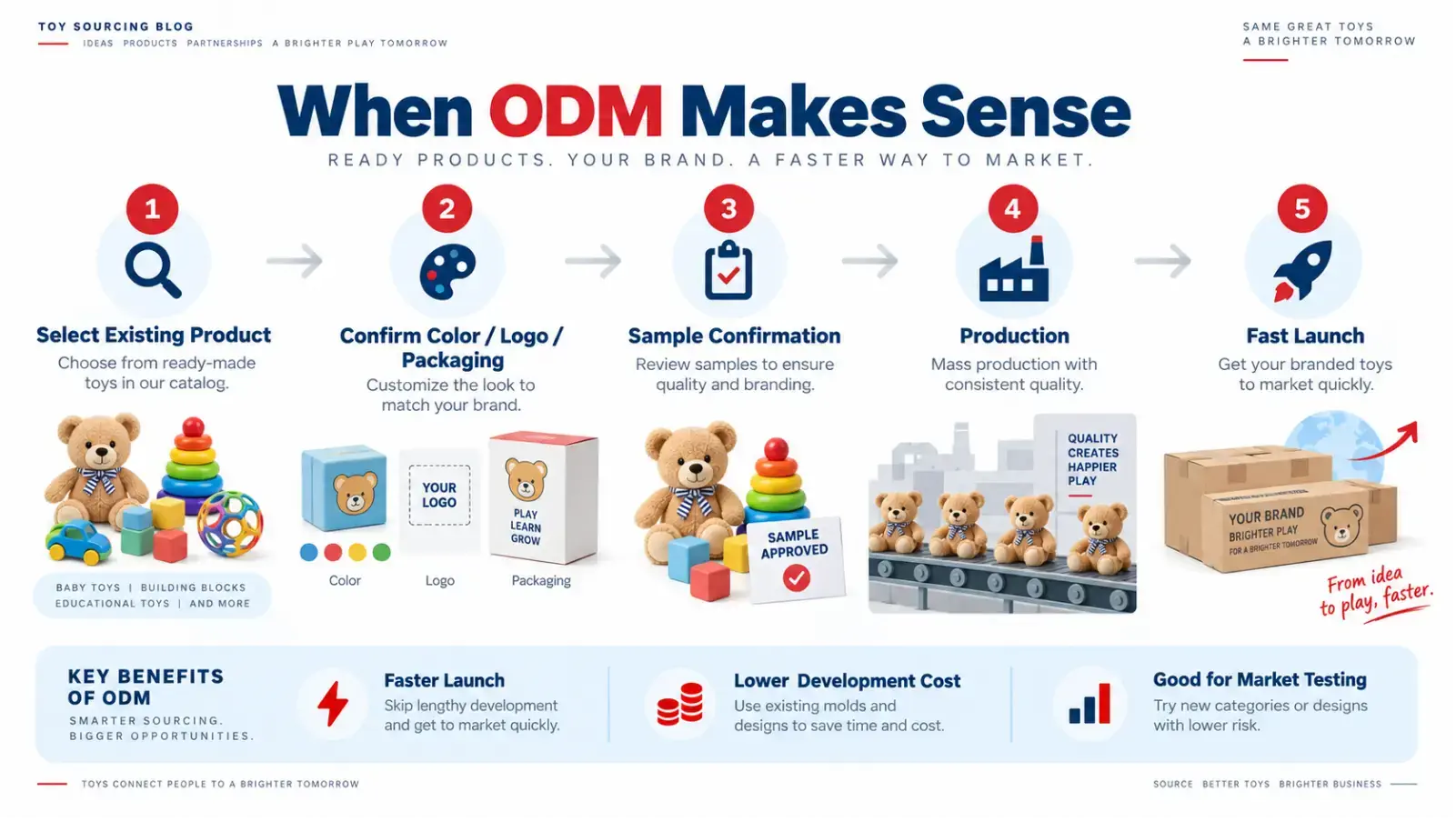
ODM is the more practical choice when speed and efficiency matter more than full originality.
If your goal is to launch quickly, control development costs, and adapt existing products for your market, ODM usually makes much more sense.
Because the factory already has existing product structures and molds, buyers can save time and avoid the initial development burden. Instead of starting from zero, you can move directly into product selection and light customization.
Why many buyers start with ODM
ODM is attractive because it usually offers:
- lower upfront investment
- shorter development time
- lower technical risk
- faster sample confirmation
- easier testing for new markets or new categories
This makes ODM especially suitable for:
- wholesalers
- e-commerce sellers
- importers testing a new category
- gift and promotional buyers
- customers with smaller initial quantities
A practical example
If a buyer wants to launch a toy quickly and mainly needs custom color, logo, package design, or market-specific presentation, ODM is often the most efficient option.
Best fit for ODM
Choose ODM if your priority is:
- fast launch
- cost control
- flexible trial orders
- responding quickly to market trends
4. OEM or ODM: Which One Fits Your Business Better?
The better model is not the one that sounds more “custom.”
It is the one that matches your business stage, budget, time pressure, and sales strategy.
Here is a simple way to think about it:
OEM may be better if you:
- already have a product concept
- want a unique product line
- can accept mold and development cost
- are planning for long-term brand growth
- need more control over product details
ODM may be better if you:
- want to launch quickly
- need to reduce development risk
- want to test demand first
- mainly need packaging / logo / color customization
- do not require full product exclusivity
One more important point: start from the market, not the label
Some buyers ask, “Should I do OEM or ODM?” too early.
A better question is:
What is my real goal — speed, exclusivity, testing, or long-term brand positioning?
Once that is clear, the choice becomes much easier.
In many real sourcing cases, buyers may even combine both:
- use ODM to test the market first
- move to OEM later after the product direction proves successful
That can be a practical path for balancing risk and growth.
الأفكار النهائية
Choosing the right cooperation model is more important than simply asking for “full customization.”
In toy sourcing, OEM and ODM are not about which one is better in general — they are about which one is more suitable for your current business needs.
- If you want full control and stronger differentiation, OEM may be the right direction.
- If you want faster launch and lower development risk, ODM may be the smarter choice.
The key is to match the model with your product strategy, order plan, and market goals.
Need Help Evaluating OEM or ODM for Your Toy Project?
If you are not sure whether your product is more suitable for OEM أو ODM, we can help review your idea and recommend a more practical development path based on:
- your market
- target price
- customization level
- order quantity
- launch timeline
للتواصل مع ألعاب شينجي to discuss your project and find the cooperation model that fits your business better.