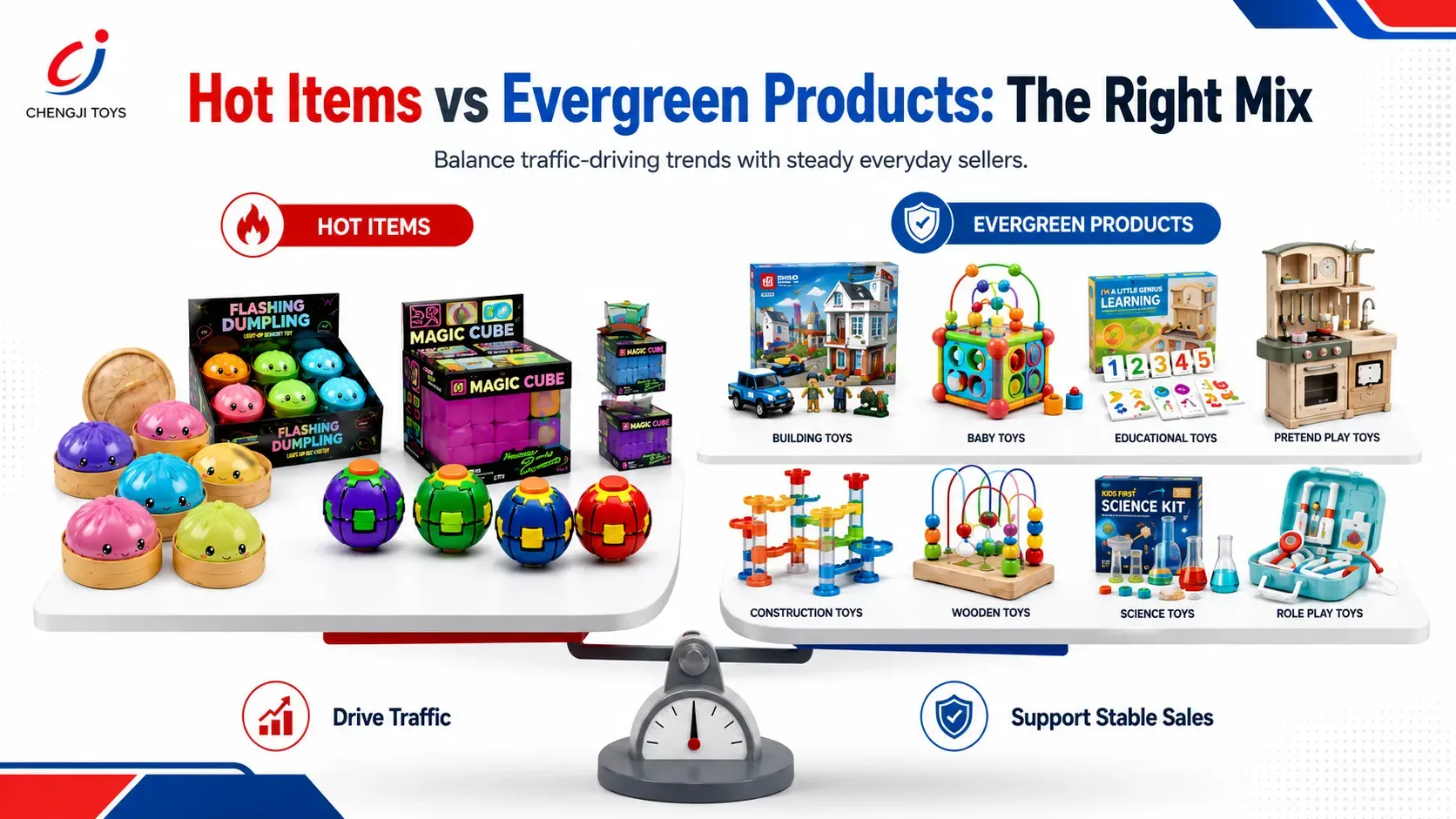
For many toy buyers, product selection often feels like a difficult trade-off.
If you put too much focus on hot-selling trending toys, you may enjoy a short burst of sales — but also face the risk of unsold stock once the trend fades. If you only choose classic steady sellers, your business may remain stable, but you could miss the chance to capture short-term traffic and seasonal demand.
In reality, hot items and evergreen products should not be treated as an either-or choice. A better approach is to build a balanced product mix that combines both. The right ratio depends on your business stage, cash-flow condition, and sales goals.
A smart toy sourcing strategy is not only about choosing “what is popular.” It is about deciding how to combine products with different sales rhythms.
Hot Items and Evergreen Products Follow Two Different Logics
Although both types of products can generate sales, they work in very different ways.
Hot Items
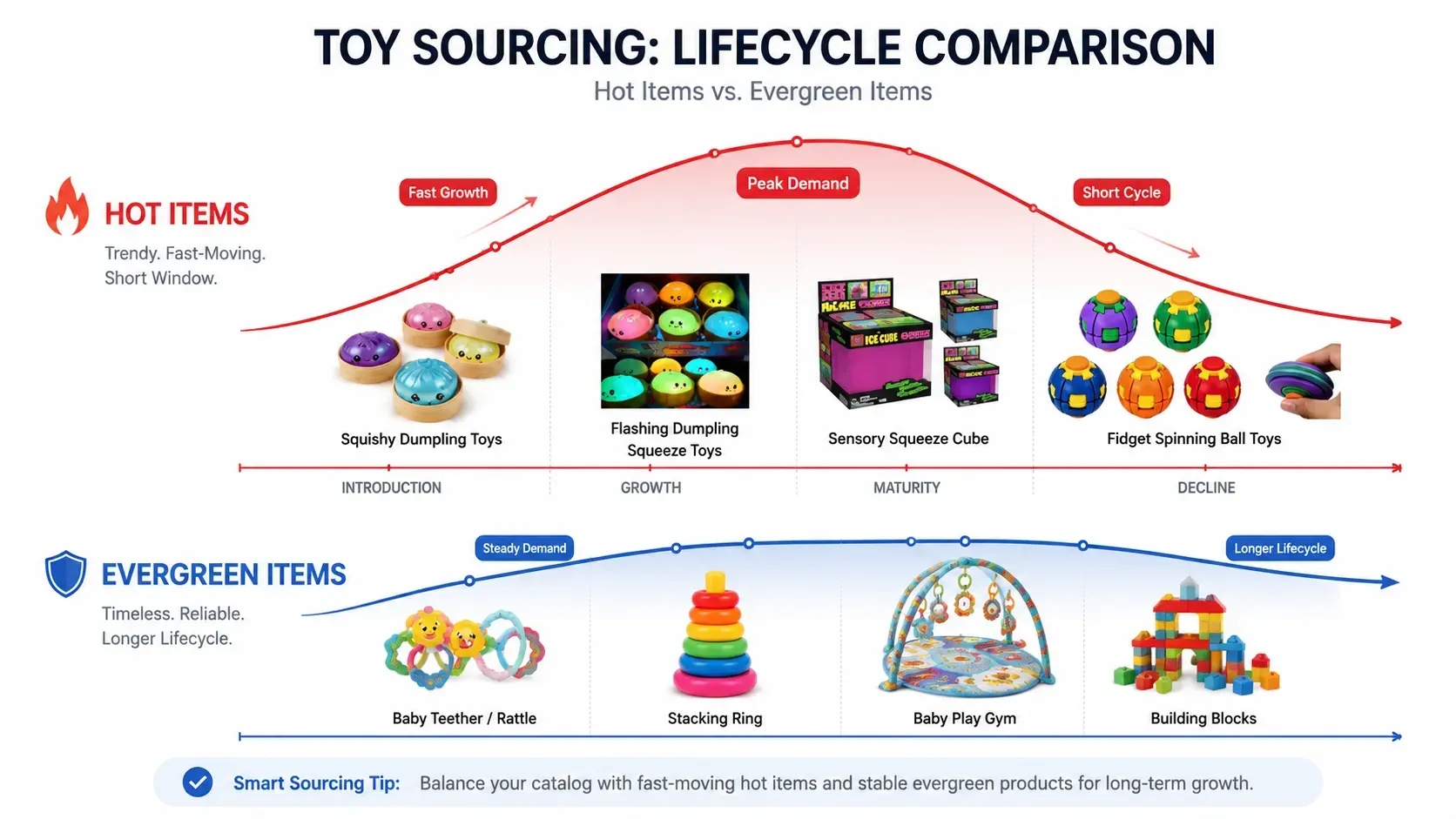
Hot items are driven by short-term attention. Their growth often depends on:
- social media exposure
- influencer promotion
- viral content
- platform traffic
- seasonal or trend-based demand
These products can grow quickly and bring strong short-term results. However, their life cycle is usually much shorter — often around 3 to 6 months. Once attention drops, sales may slow down just as fast.
That means hot items offer high upside, but also higher risk.
Evergreen Products
Evergreen products are built on more stable demand. Their performance usually comes from:
- everyday play value
- broad age suitability
- repeat purchase demand
- practical retail performance
- long-term market acceptance
These products may not create sudden traffic spikes, but they often sell steadily over time. Their life cycle can last for years. Margins may be lower on each batch, but they help reduce risk and support healthier inventory turnover.
For many buyers, evergreen products are the real foundation of long-term cash flow.
Why the Mix Matters
A business built only on hot items may grow fast but become unstable. A business built only on steady sellers may be safe but less dynamic.
That is why the ideal sourcing strategy is usually a combination of traffic-driving products and stable turnover products.
The Right Ratio Depends on Your Business Stage
There is no single perfect ratio for every buyer. The best product mix changes according to business maturity and risk tolerance.
Startup or Early-Stage Buyers
If you are still building your product line or testing your market, it is usually safer to keep evergreen products above 70%, while limiting hot items to 30% or less.
This approach helps:
- protect cash flow
- reduce the risk of slow-moving inventory
- create a stable sales base
- allow small-scale testing of trend products
At this stage, hot items should work more as traffic experiments than as the core of the product structure.
Established or Stable Operators
Once your business already has a clearer sales rhythm and stronger product turnover, the ratio can be more balanced. In many cases, a 50/50 mix between evergreen items and hot items works well.
This allows:
- evergreen products to support daily turnover
- hot items to create new demand and freshness
- better flexibility for seasonal testing
- more room to react to market trends
A balanced mix is often suitable for buyers who already understand their customer base and have a more stable replenishment rhythm.
Peak-Season Planning
During key selling seasons — especially before Black Friday, Christmas, or major promotional periods — buyers may choose to increase the hot-item ratio to around 60%.
This helps capture:
- short-term traffic spikes
- gifting demand
- promotional momentum
- seasonal shelf excitement
However, a higher hot-item ratio should always be paired with a clear exit plan. Buyers should already think about:
- replenishment timing
- sell-through speed
- markdown strategy
- post-season stock clearance
Hot items can be useful in peak season, but only when they are managed with discipline.
Three Practical Ways to Apply the Right Mix
A product ratio is not only a number. It also requires practical execution. Here are three sourcing suggestions that make the strategy more workable.
1) Choose Lightly Adapted Hot Items Instead of Fully Unproven Ones
When testing trendy products, it is often safer to choose lightly adapted versions rather than completely new and highly uncertain items.
For example:
- a classic building set with a seasonal color theme
- a proven toy format with updated packaging
- a familiar category combined with a current trend element
- a standard product refreshed with new visual appeal
This kind of “lighter” hot-item strategy helps reduce development risk and avoid putting too much budget into short-lived trends.
2) Keep Evergreen Products Stable in Replenishment
Steady-selling products should not be neglected just because new trends are exciting.
A healthy evergreen line should maintain:
- regular restocking rhythm
- consistent quality
- stable packaging
- controlled inventory planning
- reliable retail presence
These are the products that keep business moving while hot items are still being tested.
3) Create a Hot-Item Observation Period
Not every trending product deserves immediate large-volume reordering.
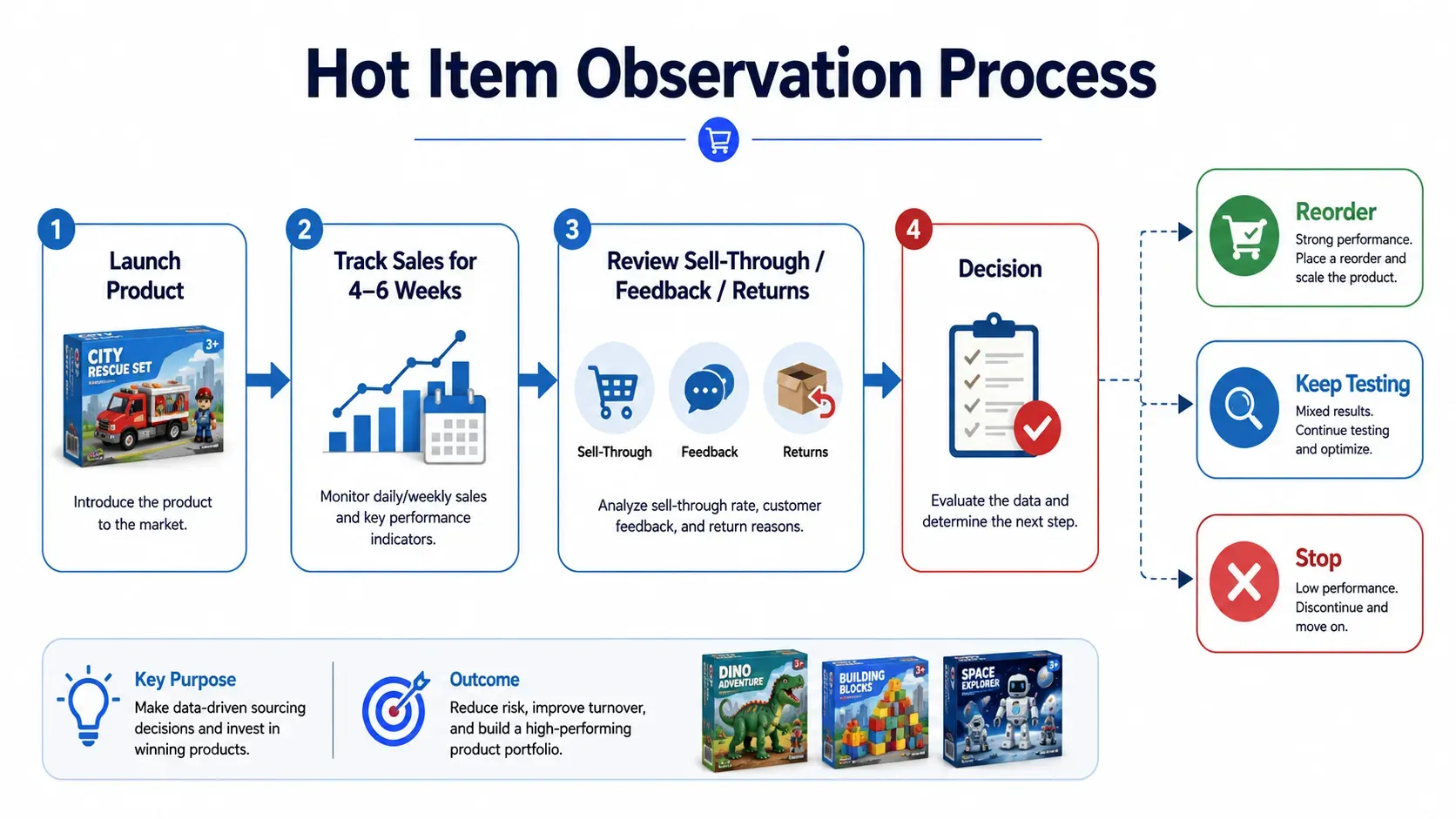
A practical method is to establish a 4 to 6 week observation period after launch. During this time, buyers can track:
- sell-through speed
- repeat demand
- customer feedback
- return or complaint rate
- whether the product keeps momentum or loses heat quickly
Based on the results, buyers can decide whether to:
- reorder
- keep testing
- reduce exposure
- stop quickly and shift budget elsewhere
This helps prevent emotional decision-making and improves sourcing accuracy.
Product Mix Is Really About Balancing Traffic and Cash Flow
Many buyers focus only on “which products can become bestsellers.” But in real business, the better question is:
Which combination of products can keep sales active while protecting cash flow?
Hot items are useful because they create attention. Evergreen products are valuable because they create continuity.
One brings traffic.
One brings stability.
Both are important.
The key is not choosing one over the other — it is learning how to balance them.
A strong product portfolio usually needs:
- a stable core of proven products
- a smaller but flexible trend-testing layer
- clear replenishment discipline
- timely sales review
- practical seasonal planning
When the product mix is structured well, buyers can reduce risk, improve stock efficiency, and create more sustainable growth.
최종 생각
A good toy sourcing strategy is not just about chasing trends or staying overly conservative. It is about finding the right balance between short-term opportunity and long-term stability.
For toy buyers, distributors, and retailers, the best product mix often combines:
- evergreen items for stable turnover
- selected hot items for growth potential
- flexible planning based on business stage
- practical tracking after launch
If you are planning your next toy sourcing cycle and want help building a balanced mix of steady sellers and current hot items, Chengji Toys can support product recommendations based on your market, budget, and sales goals.
웹사이트: chengjitoy.com
이메일: [email protected]
전화 / WhatsApp / WeChat: +86-13715966567