How Chengji Toys helped an Amazon toy seller coordinate priority production, sample consistency, and expedited ocean freight before a critical sales event.
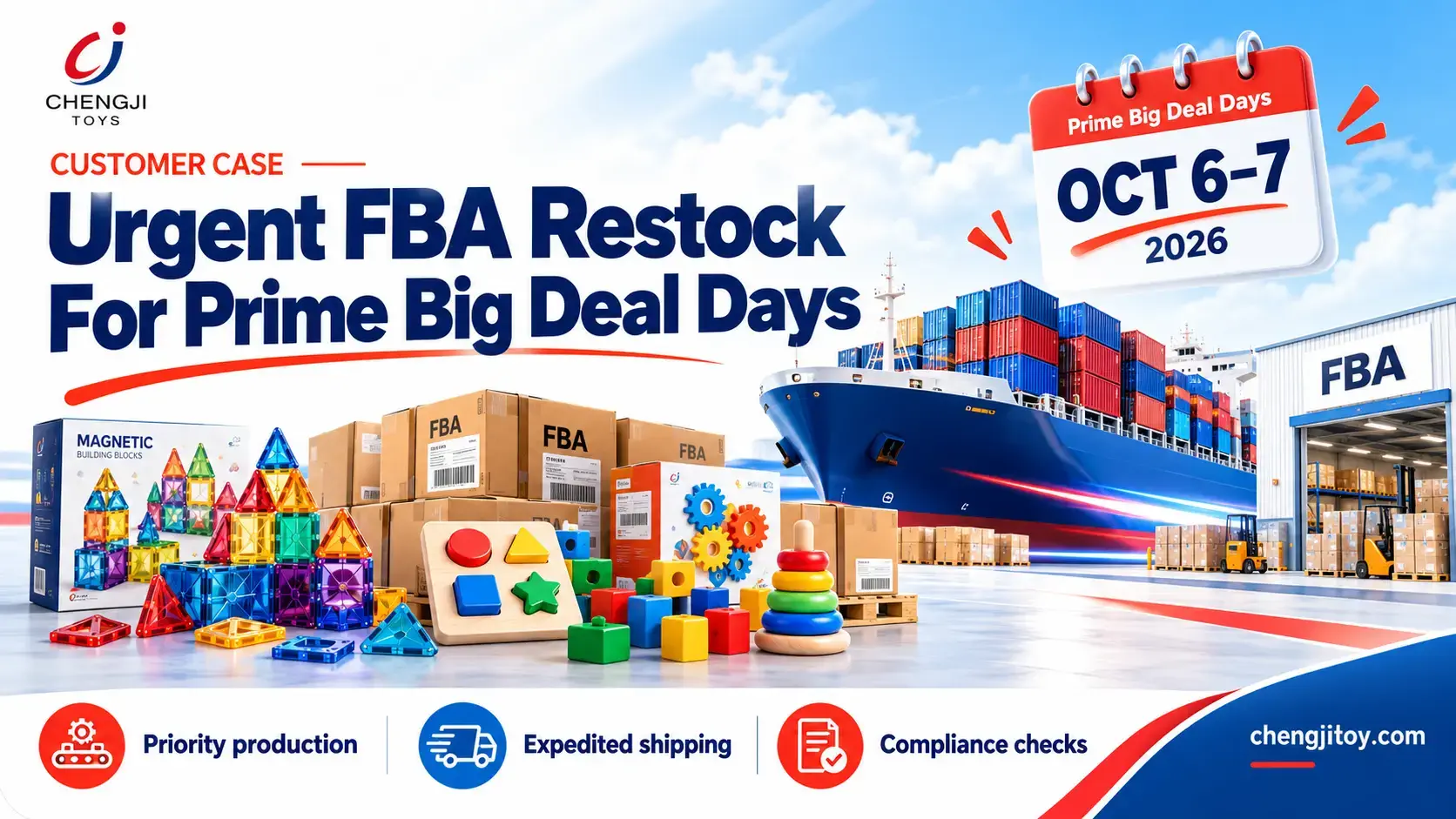
For an Amazon toy seller, a supplier delay becomes especially serious when a promotion is approaching, and a core SKU is running short. The challenge is no longer simply finding more stock. It is getting the right product into the right fulfilment channel while there is still time to sell it.
Ahead of Prime Big Deal Days, an Amazon seller serving US and European markets contacted Chengji Toys through an online inquiry. The seller’s existing supplier could no longer meet the agreed delivery schedule. A replacement order was urgent, but the requirements for product quality, sample consistency, and destination-market compliance remained unchanged.
Amazon’s announced dates for Prime Big Deal Days 2026 were October 6–7. Amazon’s event announcement provides the event context. This anonymised customer case looks at how we assessed the remaining window, coordinated the work, and helped complete the FBA replenishment in time for the promotion.
1. The Starting Point: A Core Toy SKU at Risk of Running Out
The customer sold children’s educational toys and products designed for parent-child play. One important SKU needed replenishment before the promotional period, but the original supplier’s delay put that plan at risk.
For the seller, the concern went beyond a missed delivery date. Insufficient stock could interrupt the promotion, weaken sales momentum and leave marketing plans without enough inventory behind them. Recovering that momentum after the event would create additional work.
The request to Chengji was clear: assess an urgent replenishment order without changing the product standard to make the schedule easier.
| Case element | What mattered |
|---|---|
| Customer | An Amazon toy seller serving US and European markets |
| Trigger | A core SKU needed replenishment after the original supplier delayed delivery |
| Required outcome | Complete FBA replenishment within the window needed for the promotion |
| Non-negotiable requirements | Destination-market requirements and consistency with the confirmed sample |
| Execution approach | Priority production, retained samples, coordinated documents and expedited ocean freight |
There was no value in promising a fast factory completion date if the goods would still miss the receiving window. We first needed to assess the entire journey.
2. Before Production: Decide Whether the Order Is Feasible
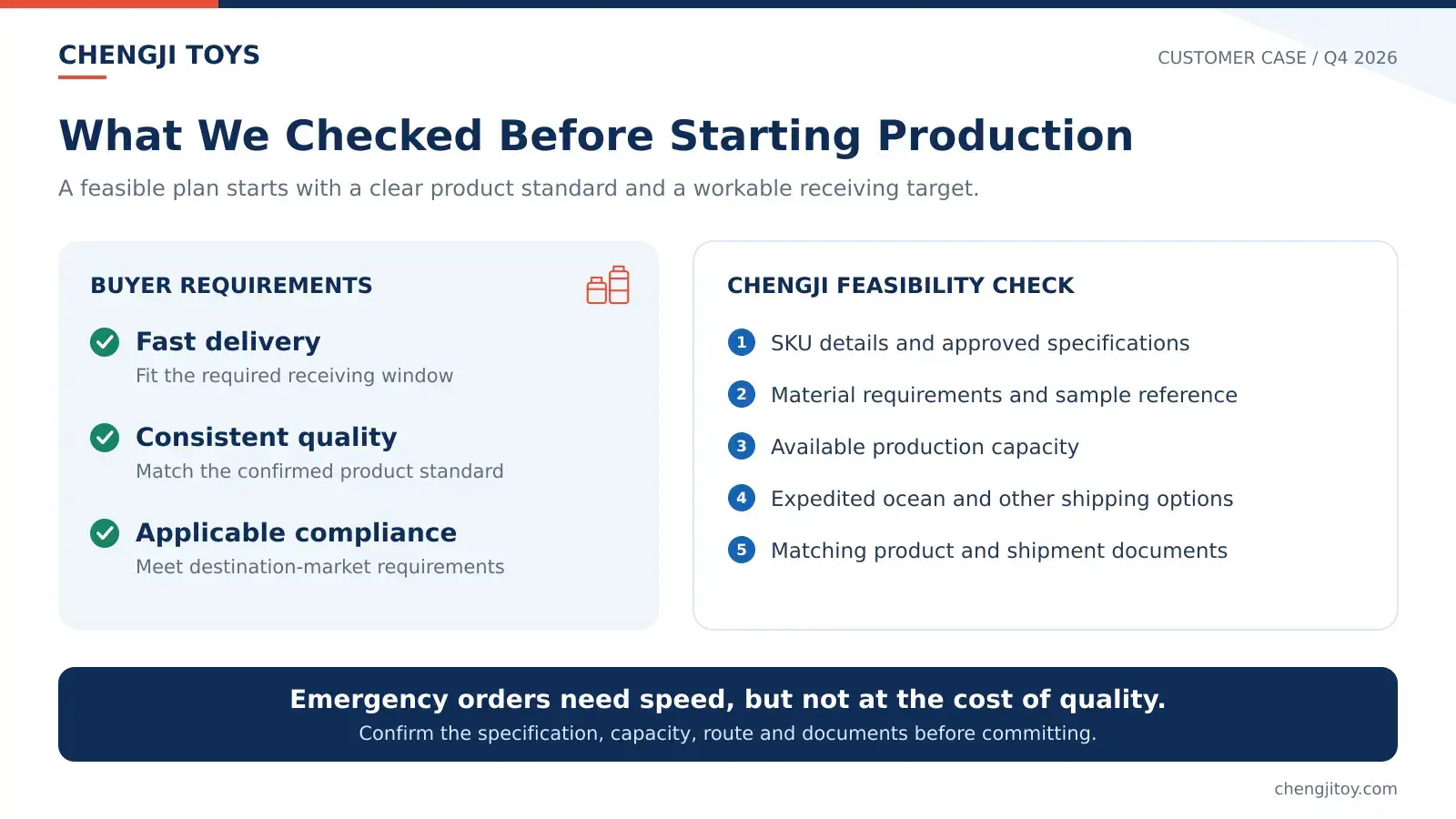
An urgent inquiry deserves a fast response, but a useful response must be based on the product, available capacity and the remaining logistics window. We reviewed four areas before committing to the execution plan.
Confirm the SKU and the required standard
We checked the product details, material requirements and the documentation relevant to the intended market. The purpose was to establish what the replacement order needed to match, rather than treating a visually similar toy as an interchangeable substitute.
For US-bound children’s products subject to applicable CPSC rules, the Children’s Product Certificate (CPC) is a certificate, not a laboratory test report. The responsible domestic manufacturer or importer issues it using the required supporting evidence, generally including testing by a CPSC-accepted third-party laboratory. Product identification and the applicable requirements must match the goods being supplied. See the CPSC’s CPC guidance.
In this case, the document review formed part of the feasibility check. A familiar product description or an existing file was not enough on its own. For European destinations, the applicable requirements and documentation need a separate assessment; a US CPC does not replace them.
Work backwards from the receiving target
We assessed the shipping options against the customer’s required FBA replenishment window. Standard ocean freight presented too much timing risk for this order, so the plan moved to an expedited ocean service.
The relevant question was whether production, export handling, the sailing, customs clearance, and final delivery could fit together. A shorter advertised sailing time alone would not answer it. The exact receiving target also had to come from the seller’s marketplace and shipment plan, rather than from a generic deadline applied to every FBA shipment.
Confirm usable production capacity
Drawing on Chengji’s sourcing network in the Chenghai toy manufacturing cluster, we assessed the available production arrangement and confirmed that the order could receive priority scheduling.
Priority scheduling meant reducing waiting time and coordinating resources. It did not mean replacing the approved material, removing accessories, or skipping the checks needed to keep bulk production consistent with the sample.
Prepare documents alongside production planning
We started organising the customs and FBA shipment documentation while the production plan was being settled. This reduced the risk of finished goods waiting for missing information at the end.
For current US-bound orders, the importer and customs broker should also check applicable CPSC certificate eFiling requirements. Document preparation needs to reflect the actual shipment, not just a standard folder of certificates.
3. Execution: Reduce Waiting Time, Keep the Product Standard
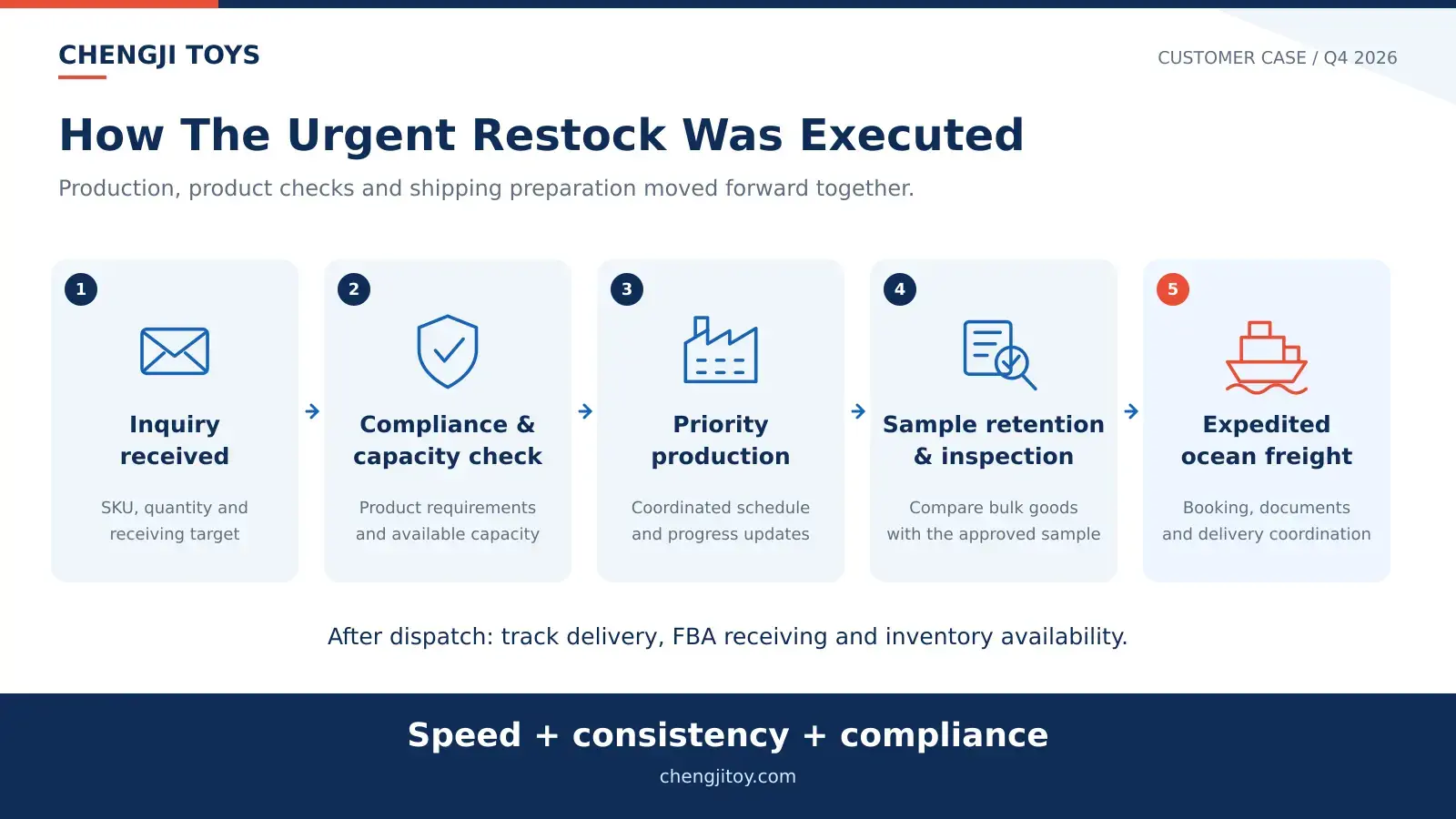
Once the order was assessed as feasible, the work moved forward across production, quality control, and logistics together.
Priority production with progress updates
Chengji coordinated the production schedule and shared production images with the customer as the order progressed. That gave the seller visibility into the work instead of relying only on a promised completion date.
Progress updates also supported practical decisions. A shipping plan depends on when the goods will actually be ready, so changes on the production side need to reach the logistics team promptly.
Retained samples as the production reference
We kept confirmed samples as the reference for checking the bulk goods. This addressed a concern that becomes particularly important when an order moves to a different supplier: similar appearance does not automatically mean the same specification.
The agreed product remained the benchmark for materials, appearance, accessories, and packaging. Retaining the sample made that benchmark available during production and before shipment. Production images helped communication, while physical checks served a different purpose: checking the goods against the agreed standard.
Expedited ocean freight and shipment preparation
Chengji coordinated the expedited ocean booking and the paperwork needed for the shipment. The production and shipping tasks were managed as one connected schedule, so goods readiness, booking requirements, and final delivery arrangements could be aligned.
For sellers assessing a similar order, this is where precise shipment information matters. Commercial documents, packing details, and the unit or carton labels required by the chosen FBA workflow need to agree with the goods. A fast vessel cannot correct an incorrect label or resolve an incomplete customs declaration.
Follow the shipment through receiving
The operational objective was FBA replenishment, so shipment departure was only an intermediate milestone.
Sellers should also distinguish carrier delivery, Amazon receiving, and inventory availability for immediate fulfilment. Amazon explains that units can become available for sale as they are received, while transfers between fulfilment centres can affect when they are ready for immediate shipping. The seller should check shipment and inventory status in Seller Central rather than relying only on a delivery receipt. See Amazon’s explanation of receiving status.
4. The Result: FBA Replenishment Completed for the Promotion
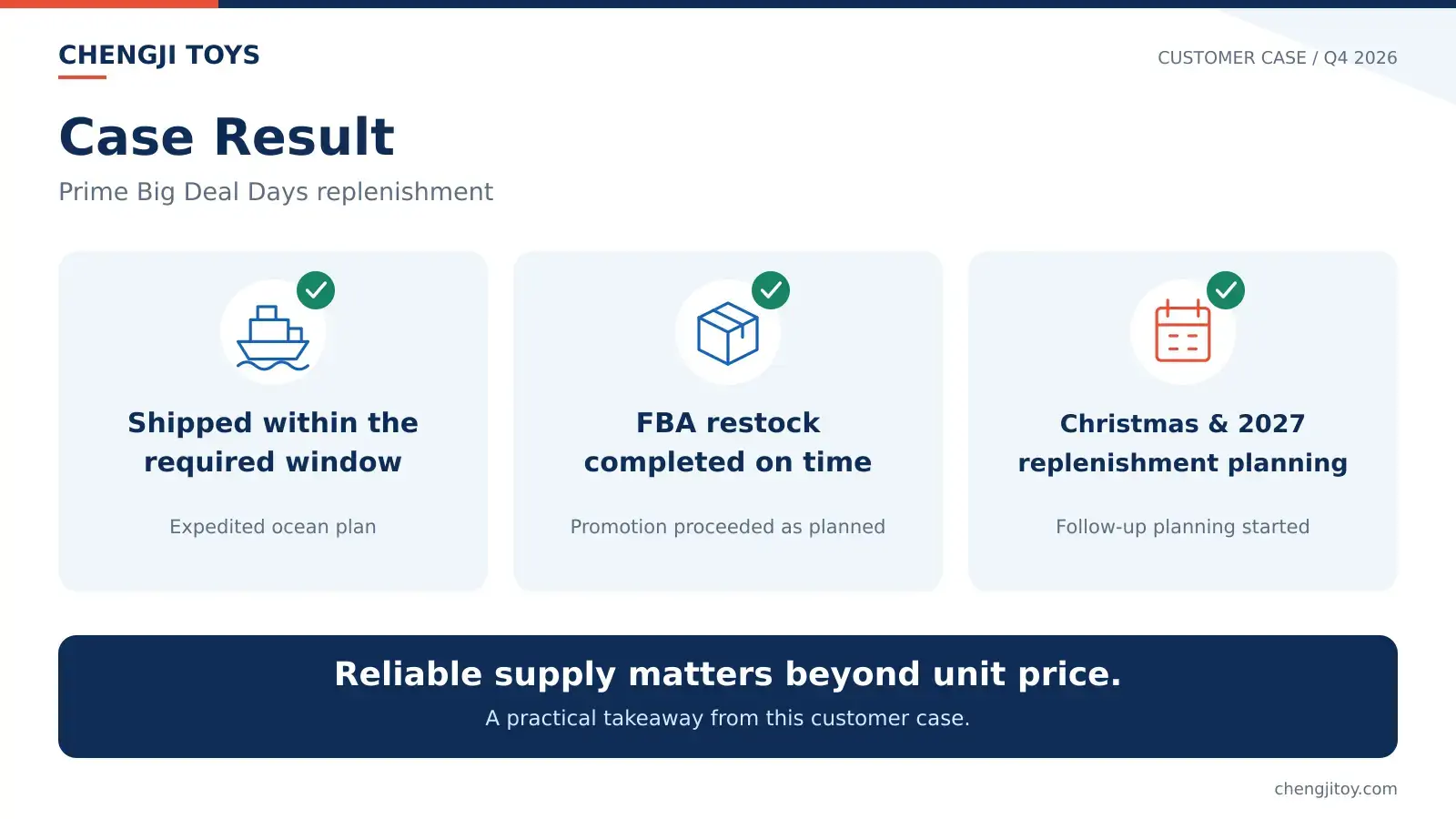
The goods shipped within the required window, and the FBA restock was completed in time for the customer’s Prime Big Deal Days promotion to proceed as planned.
After the urgent order, the conversation moved to replenishment planning for Christmas and early 2027. The focus shifted from solving one immediate shortage to organising the next orders before another tight window developed.
In the customer’s feedback, supply stability mattered more than simply obtaining the lowest unit price. That is the practical lesson of the case: a quotation needs to be assessed alongside the supplier’s ability to deliver the agreed product within a workable schedule.
This outcome depended on the capacity and shipping options available for this particular order. It is not a fixed turnaround promise for every urgent FBA shipment.
5. What Other Toy Sellers Can Apply to Their Next Restock
This case puts Q4 shipping calendars and stockout-risk planning into practice. The key is to identify the constraint early enough to choose an executable response.
Start with stock coverage and the required selling date. Tell the supplier which SKU is at risk, the replenishment quantity, and when the stock needs to support sales. Distinguish the requested factory release date from the destination receiving target.
Confirm the specification before comparing emergency options. An alternative supplier should assess the actual product and approved standard. A lower price or shorter lead time is difficult to evaluate when materials, contents, or packaging differ.
Compare the complete shipping plan. Ask what is included between factory release and FBA delivery, which milestones need confirmation, and where contingency time remains. Expedited ocean worked for this case; another order may require a different option, a smaller first shipment, or a revised sales plan.
Evaluate the extra cost against the inventory gap. Expedited freight can add cost. The decision should consider how much stock is needed for the immediate sales window and whether later replenishment can use a more economical schedule. There is little benefit in moving the entire order urgently if only part of it is needed immediately.
Keep the next replenishment cycle visible. Once the immediate shortage is addressed, separate Christmas demand from early-2027 requirements. Confirm quantities and production opportunities in stages rather than allowing every follow-up order to become another emergency.
At Chengji, our approach is to check feasibility before making a commitment, reduce avoidable waiting without lowering the agreed standard, and coordinate production, logistics, and documents throughout execution.
Need an Urgent FBA Toy Restock Plan?
If a supplier delay or inventory gap is putting your next sales window at risk, send Chengji your SKU or product specification, quantity, destination marketplace, and target delivery date. If available, include the approved sample details, existing test documentation, and current FBA shipment requirements.
We will assess the production and shipping options against your remaining timeline and explain which parts can be confirmed. The earlier that assessment starts, the more room there is to choose a workable plan.
웹사이트: chengjitoy.com
이메일: [email protected]
전화 / WhatsApp / WeChat: +86-13715966567