Most toy suppliers focus only on one question:
“Can we close this order?”
But far fewer stop to ask a more important one:
“Why do some buyers disappear after one order, while others keep reordering for years?”
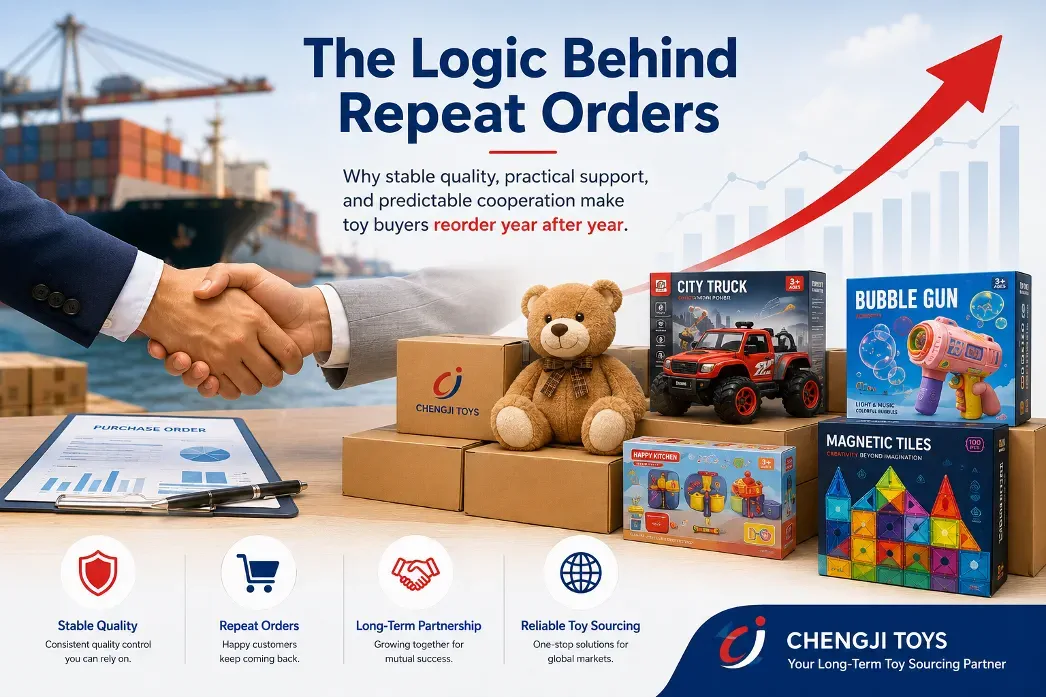
In the toy business, long-term cooperation is rarely built on a single low price or a one-time successful shipment. What truly drives repeat orders is whether a supplier can keep delivering predictable value over time.
For buyers, especially importers, distributors, and retail customers, the best supplier is not simply the cheapest one. It is the one that reduces uncertainty, supports business growth, and stays reliable across multiple orders.
Why Do So Many Toy Supplier Relationships End After Just One Order?
Many business relationships in the toy trade begin quickly but end just as quickly. In most cases, the reason is not the product itself. It is the lack of long-term cooperation logic behind the order.

1. Orders Won by Price Are Often Lost by Price
Some buyers place the first order because a supplier offers a very low price. But if price is the only reason the cooperation starts, price will also be the reason it ends.
When the next order comes, the buyer may simply compare again and move to another supplier offering a lower quotation. Without added value, there is little loyalty and no real reason to stay.
2. Inconsistent Quality Breaks Trust Quickly
Another common problem is inconsistency between samples and bulk goods.
A sample may look good, but if the mass production quality drops, the supplier loses credibility immediately. For buyers, one unstable shipment is often enough to create hesitation for future orders.
In many cases, repeat business is not lost because of one major failure, but because the buyer no longer feels confident about what the next order will be like.
3. A Purely Transactional Relationship Has Limited Future
Some suppliers only discuss unit price, delivery time, and packing details. They do not ask how the buyer sells the products, what retail channels they serve, or how market demand may be changing.
As a result, when the buyer’s needs evolve, the supplier cannot offer relevant support. The relationship stays transactional and does not develop into long-term cooperation.
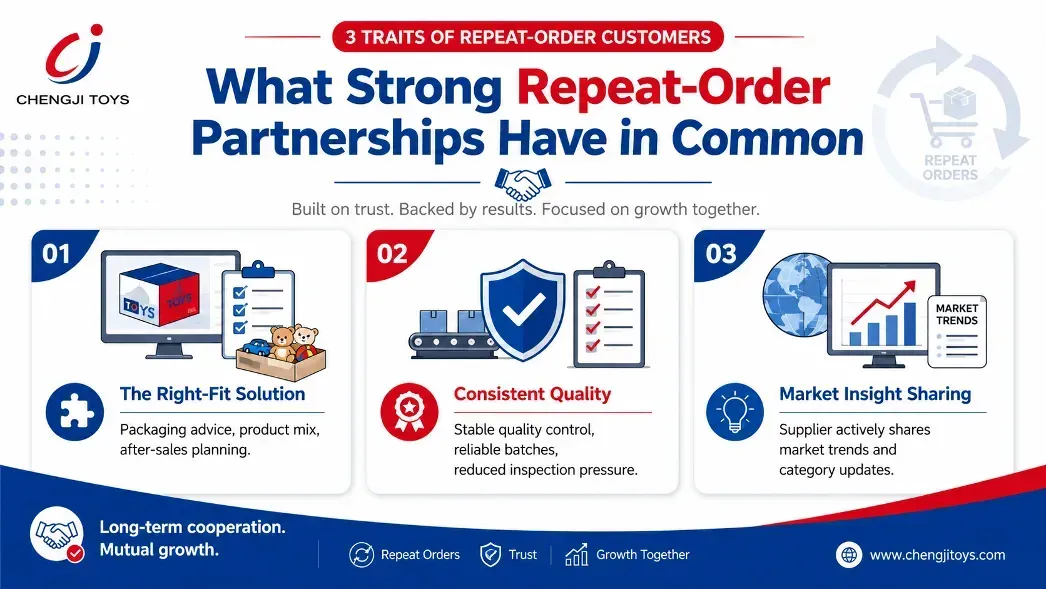
Three Common Traits of Buyers Who Reorder Consistently
Long-term repeat-order customers may serve different markets and channels, but many of them stay with the same supplier for similar reasons.
1. They Receive the Most Suitable Solution, Not Just the Lowest Price
At the beginning of the cooperation, strong suppliers do not only send a quotation. They also provide a more complete solution based on the buyer’s actual needs.
This may include:
- packaging suggestions
- product mix recommendations
- more suitable styles for the target market
- after-sales risk reminders
- practical alternatives within the buyer’s budget
For buyers, this creates confidence. It shows that the supplier is not just trying to sell a product, but is trying to help the order perform better in the real market.
2. Product Quality Stays Within a Reliable Range
Repeat-order buyers do not expect every shipment to be perfect in theory. What they truly value is stability.
If the supplier can proactively control quality variation and keep each batch within an acceptable and consistent standard, the buyer feels safer placing repeat orders.
This reduces:
- inspection pressure
- after-sales risk
- internal complaints
- retail uncertainty
For long-term buyers, consistency is often more valuable than squeezing out the lowest possible price.
3. The Supplier Shares Market Insight Instead of Waiting Passively
Strong long-term suppliers do not wait until the buyer asks questions. They actively share useful market observations.
For example:
- a category may be slowing down in retail
- a product style may be losing momentum
- a new category may be growing in demand
- a certain packaging direction may be working better in similar markets
This kind of communication helps the buyer stay ahead instead of reacting too late. Over time, the supplier becomes more than a vendor — they become a practical business partner.
How to Turn a One-Time Order into Long-Term Repeat Business
Long-term reorders do not happen automatically after the first shipment. They usually come from what the supplier does after the order is delivered.
1. Follow Up on Sales Feedback After Delivery
For many suppliers, service ends once the goods are shipped. But for long-term cooperation, delivery should not be the final step.
A better approach is to follow up with the buyer after the first order and ask questions such as:
- How did the products perform in the market?
- Were there any issues with packaging, display, or customer reaction?
- Which items moved faster?
- Which styles may need adjustment for the next order?
This shows that the supplier cares about the buyer’s sell-through, not just the shipment itself.
2. Offer Suggestions Before the Buyer Has to Ask
For buyers who purchase similar categories regularly, suppliers should not remain passive between orders.
Instead, they can:
- recommend seasonal adjustments
- suggest better-selling alternatives
- advise on packaging upgrades
- prepare next-quarter product options early
- warn about slower-moving categories
This kind of proactive support helps the buyer plan better and makes the supplier more difficult to replace.
3. Prioritize Consistency Over Short-Term Price Competition
Many suppliers focus too much on offering the lowest price for the current order. But for repeat business, product consistency matters more than short-term price reduction.
If a lower price leads to unstable materials, weaker workmanship, or packing changes that create complaints later, the long-term cost becomes much higher than the short-term savings.
For repeat-order customers, the real driver is not a price war. It is the confidence that each order will arrive in a stable, manageable, and commercially reliable way.
What Long-Term Buyers Really Want from a Toy Supplier
In the end, repeat orders are usually built on three things:
- reliable quality
- practical support
- predictable cooperation
Buyers reorder when they feel that working with a supplier makes their own business easier, safer, and more stable.
That is why the most valuable suppliers are not necessarily the cheapest. They are the ones who can continue to provide certainty in product quality, communication, planning, and market relevance.
최종 생각
The most valuable part of a business relationship is not the profit from a single order.
It is the buyer’s willingness to come back again next season, next year, and year after year.
In the toy business, repeat orders are rarely won by price alone. They are earned through stable quality, practical service, and the ability to support the buyer’s business beyond the transaction itself.
If you would like to learn more about how Chengji Toys supports long-term customer cooperation with stable sourcing, product consistency, and ongoing market-based recommendations, feel free to contact us.
웹사이트: chengjitoy.com
이메일: [email protected]
Phone / WhatsApp / WeChat: +86-13715966567