A child builds a magnetic tile tower. It falls. Instead of rebuilding it in exactly the same way, the child changes the base, rearranges the pieces, and tries again.
This simple sequence illustrates an important aspect of magnetic block play: learning can occur through the process of building, observing, adjusting, and rebuilding, rather than through the finished structure alone.
Magnetic building blocks provide opportunities for children to practice problem-solving skills through direct interaction with shapes, structures, and physical forces. Understanding these learning patterns also helps educational toy retailers and brands recognize the play value behind different product designs.
Why Magnetic Block Play Encourages Trial-and-Error Learning
Magnetic building blocks combine several design characteristics that make experimentation accessible.
| Product Feature | Learning Opportunity |
|---|---|
| Magnetic connections | Immediate feedback when pieces connect or separate |
| Reversible assembly | Structures can be modified without starting entirely from scratch |
| Modular components | Different pieces can be combined to solve the same construction problem |
| Geometric shapes | Children can explore size, orientation, and spatial relationships |
These features support a constructivist approach to learning, in which children develop their understanding through active interaction with materials.
For example, when a child changes the position of a magnetic tile and observes how the structure responds, the activity provides an opportunity for cause-and-effect learning. The child begins to recognize relationships between an action and its consequences.
The ability to modify structures also makes trial-and-error learning a natural part of play. Rather than treating an unsuccessful construction as the end of an activity, children can explore an alternative.
These characteristics complement the broader benefits of independent and creative play with magnetic building blocks.
How Children Move from Trial and Error to Problem Solving
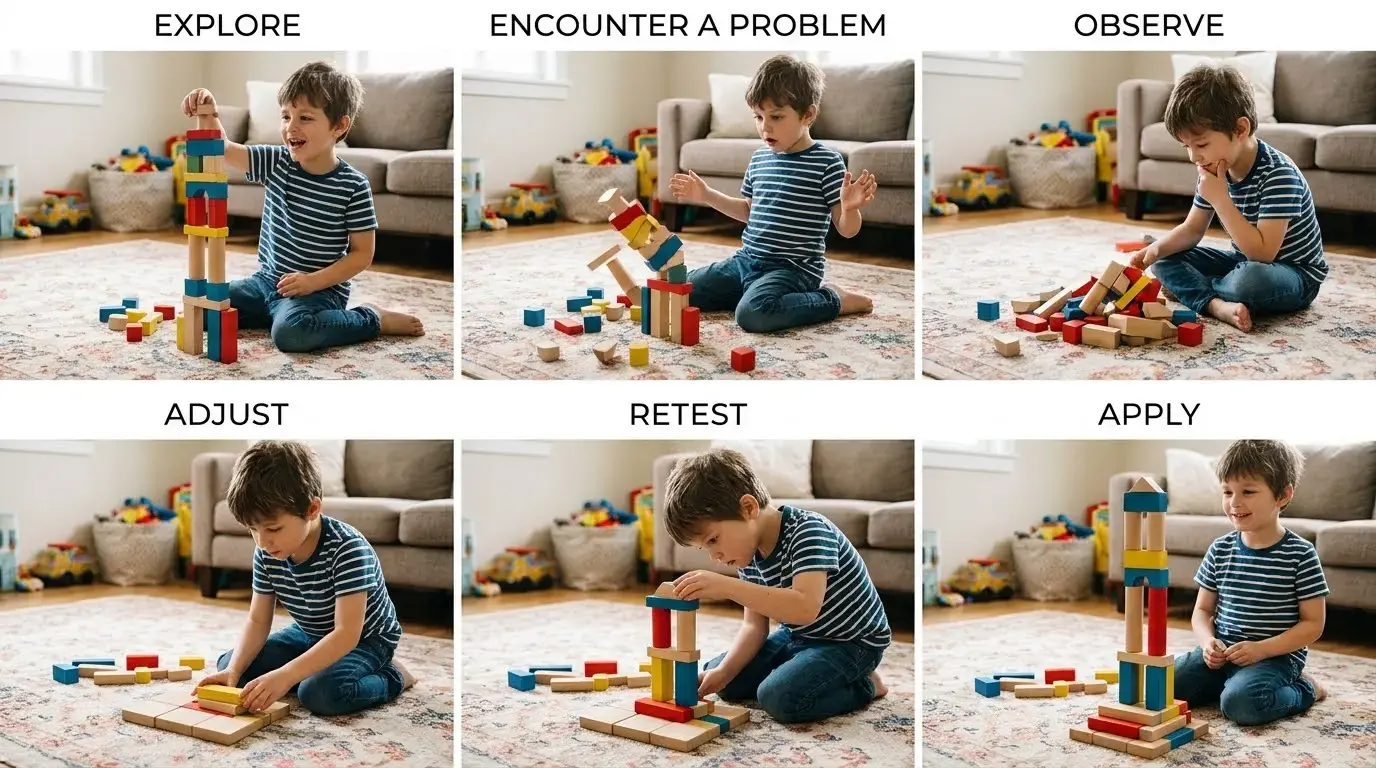
Consider a simple challenge: building a tower with magnetic tiles that can stand without external support.
Throughout the activity, several learning behaviors may emerge.
Exploration and Problem Recognition
Initially, children may connect pieces without a specific construction goal. This helps them become familiar with shapes, magnetic connections, and the behavior of different components.
Once they attempt to build a tower, a more defined problem may emerge. The structure might lean, separate at a connection, or collapse when additional pieces are added.
Recognizing the difference between the intended result and the actual outcome creates an opportunity for problem-solving.
Observation and Strategy Adjustment
After a tower collapses, a child may notice that its base is narrow or that one side contains more pieces than the other.
The child can then try a wider base, redistribute the pieces, or add supporting walls. These adjustments reflect experiential learning, where direct experience provides information that can guide subsequent actions.
Retesting and Applying Experience
Rebuilding allows the child to observe whether the modification produces a different result. If the structure remains unstable, another adjustment may be necessary.
Over time, children may begin to use previous construction experiences when approaching similar challenges.
"(《世界人权宣言》) Education Development Center’s guidance on building activities identifies prediction, observation, testing, and design revision as opportunities for early scientific and engineering thinking.
These behaviors do not represent a fixed developmental sequence. Children may repeat certain steps, skip others, or change their original construction goals during play.
When Does Trial and Error Become Meaningful Learning?
Repeated activity does not always serve the same learning purpose. The way children respond to feedback can influence what they discover during magnetic block play.
Three common patterns illustrate this distinction.
| Learning Pattern | Example | Learning Opportunity |
|---|---|---|
| Repetitive exploration | Connecting and separating the same two pieces | Becoming familiar with magnetic connections |
| Exploratory play | Trying different shapes and arrangements | Discovering new construction possibilities |
| Purposeful experimentation | Changing a specific part of an unstable structure | Investigating whether a modification solves the problem |
Repetition is valuable because it allows children to become comfortable with unfamiliar materials. Exploratory play expands their understanding of what those materials can do.
Purposeful experimentation introduces a more focused question. For instance, a child may keep the height of a tower unchanged while widening its base to see whether stability improves.
Research on preschool children’s exploratory play suggests that children can select informative experiments when the cause of an observed outcome is uncertain.
Although the research was not conducted specifically with magnetic building blocks, it helps explain why opportunities to manipulate components and observe different results are valuable in construction toys.
Recognizing Problem-Solving Behaviors Beyond the Finished Build
A completed structure does not necessarily reveal how a child solved the problems encountered during construction.
One child may follow illustrated instructions to build a bridge. Another may discover a workable design through exploration. A third may deliberately change the bridge’s supporting structure after an unsuccessful attempt.
Each approach offers different learning opportunities.
| Learning Behavior | Example in Magnetic Block Play |
|---|---|
| Problem recognition | Noticing that a roof does not fit between two walls |
| Spatial reasoning | Rotating a triangular tile to find a suitable orientation |
| Planning | Selecting pieces before beginning a construction |
| Cognitive flexibility | Finding an alternative when a required piece is unavailable |
| Evaluation | Checking whether a modified structure works as intended |
An observation published by Early Math Counts describes children using four smaller magnetic squares to replace a large square when the larger pieces were unavailable.
This example illustrates cognitive flexibility: adapting a solution when the available resources change. It also involves understanding how smaller shapes can combine to occupy a larger area.

Following instructions remains valuable for practicing sequencing and shape recognition. However, construction activities that allow independent decisions provide additional opportunities to practice problem-solving skills.
Products offering different levels of complexity can accommodate these varying approaches. Explore our guide to magnetic building blocks for different skill levels for further examples.
From One Building Challenge to Another: Learning Transfer
Learning transfer describes the application of previously acquired knowledge or experience to a new situation.
In magnetic block play, a child who discovers that distributing weight and adding support can improve a tower’s stability may later consider similar principles when constructing a bridge.
The two structures are different, but they involve related construction problems.

Educational research generally distinguishes between two forms of transfer:
- Near transfer: Applying previous experience to a similar activity, such as building a different magnetic structure.
- Far transfer: Applying knowledge or skills to a substantially different task, such as solving an unrelated mathematical problem.
A study published in Developmental Science found some evidence of learning transfer following LEGO construction training, although the overall effects were limited.
This distinction matters when evaluating educational toys. Magnetic building blocks can provide opportunities to reuse construction strategies, but this does not automatically translate into improved academic performance.
Product value is better communicated through specific activities and learning opportunities than through broad promises about intelligence or academic achievement.
How to Create More Meaningful Problem-Solving Opportunities
Open-ended play allows children to choose their own construction goals, while simple challenges can introduce problems that encourage more focused exploration.
The objective is to create a task with several possible solutions rather than requiring children to reproduce a single correct model.
| Building Challenge | Learning Opportunity |
|---|---|
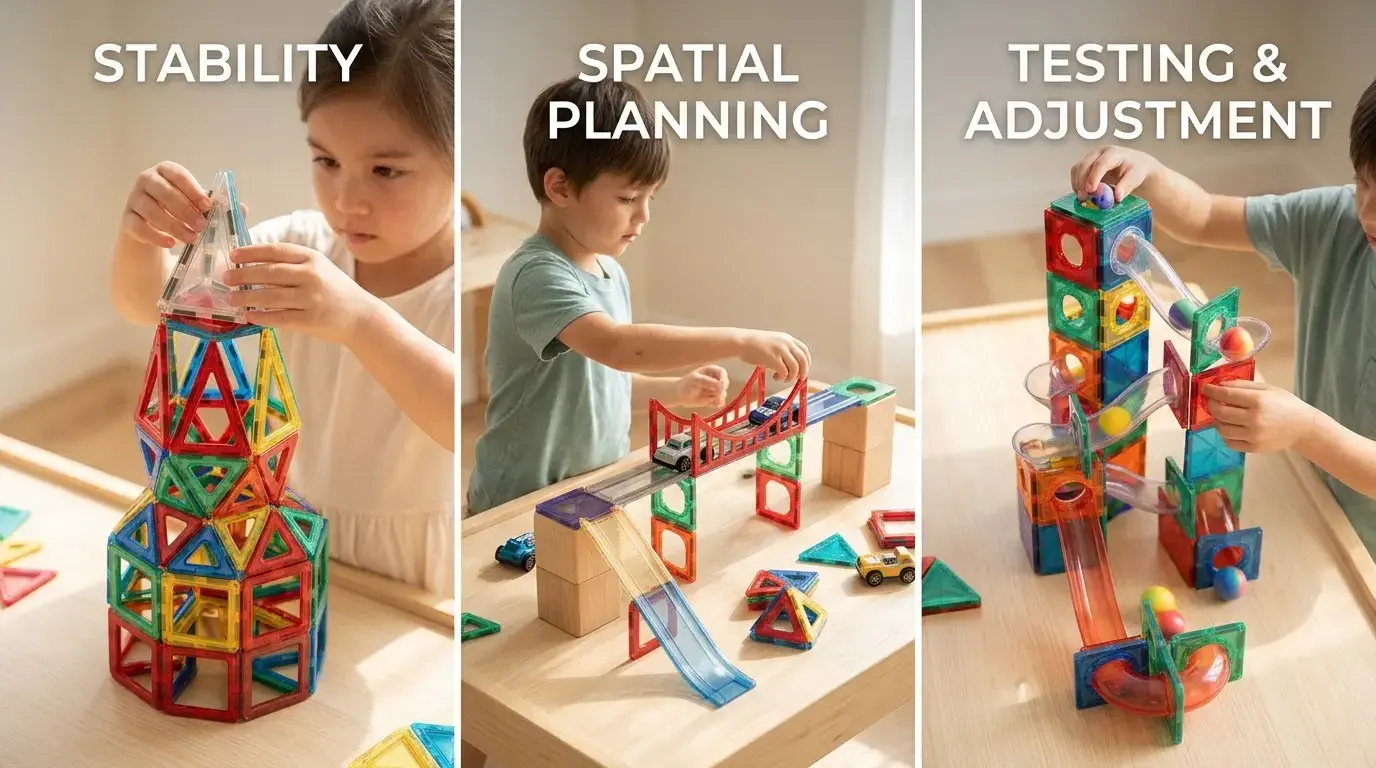
| Build a freestanding tower | Investigating balance, weight distribution, and stability |
| Build a bridge for a toy car | Estimating dimensions, planning space, and arranging supports |
| Complete a marble run | Predicting movement, observing results, and modifying track layouts |
Adults can also use guided play to support exploration without taking control of the activity. This approach relates to educational scaffolding, where temporary assistance helps children work through challenges.
Simple questions can encourage observation and independent decisions:
- What do you notice about your structure?
- What could you change?
- Is there another way to solve the problem?
A systematic review of guided play identified benefits for certain learning outcomes, including shape knowledge and early mathematical skills, although advantages were not consistent across all outcomes.
For educational toy brands, optional challenge cards and open-ended activity suggestions can therefore complement conventional building instructions without limiting children’s creative choices.
How Magnetic Block Design Shapes Learning Opportunities
Different magnetic construction toys allow children to explore different types of problems. The available shapes, connection methods, and additional components influence what can be built and tested.
| Magnetic Toy Type | Primary Play Opportunities |
|---|---|
| Magnetic cubes | Stacking, arranging, symmetry, and three-dimensional composition |
| Magnetic tiles | Geometric combinations, spatial orientation, and enclosed structures |
| Magnetic rods and balls | Framework construction, connection points, and geometric configurations |
| Magnetic marble runs | Motion, track design, slope adjustment, and dynamic testing |
Magnetic cubes offer relatively straightforward stacking and arrangement activities. Flat magnetic tiles allow children to investigate how two-dimensional shapes can form three-dimensional structures.
Rod-based construction sets introduce framework designs, while magnetic marble runs add a moving element. Children can observe where a marble stops or changes direction and modify the track accordingly.
For toy retailers, these differences provide practical ways to differentiate products within an educational toy assortment. A geometric tile set and a marble run may both support construction play, but they offer different challenges and play experiences.
Product selection should also account for age suitability, component safety, and applicable toy safety requirements. Loose or damaged magnetic components can present serious ingestion hazards, as explained in the U.S. Consumer Product Safety Commission’s magnet safety guidance.
Explore Magnetic Building Toys with Chengji
Chengji Toys supplies educational toys to wholesalers, importers, retailers, and international brands through its toy sourcing and partner-factory network.
Our range includes magnetic building tiles, geometric construction sets, magnetic cubes, and marble run toys, offering different play experiences for educational toy assortments.
Whether you are introducing an entry-level construction toy or expanding an existing STEM toy collection, Chengji can help identify suitable products based on your target age group, preferred play features, and market positioning.
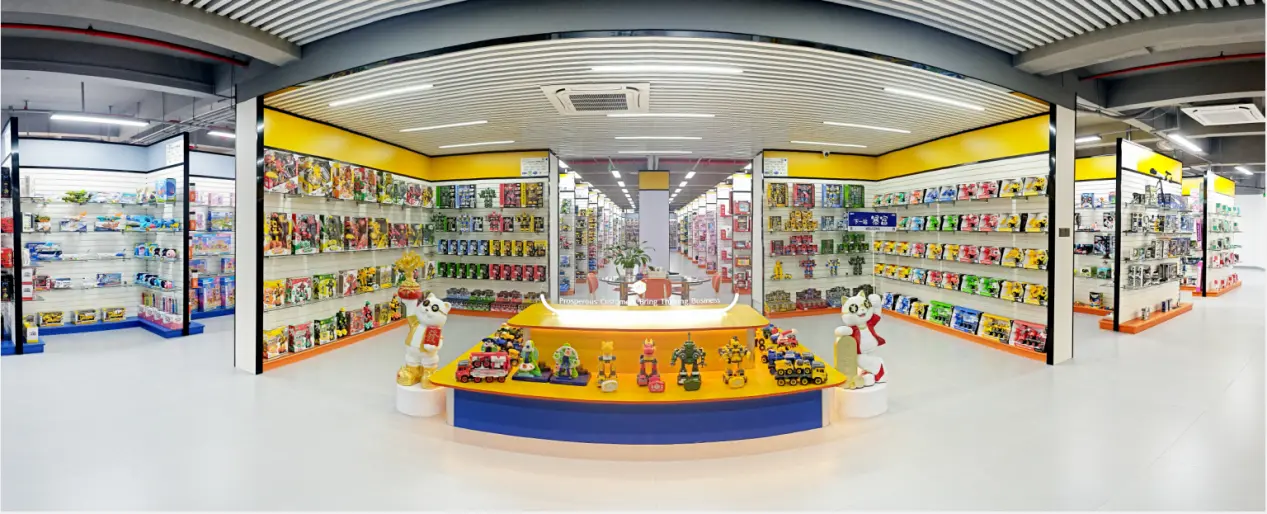
Explore our wholesale magnetic building blocks and broader collection of wholesale blocks and puzzles to find construction toys that complement your educational product range.