Social media has become an important product-discovery tool for toy buyers.
Before sending an inquiry or choosing products for the next sourcing cycle, many buyers now check TikTok, Instagram, Facebook, and other content platforms to see what is gaining attention.
This can be useful. Social media helps buyers spot emerging trends earlier and understand what kinds of products are attracting consumers.
But there is one important problem:
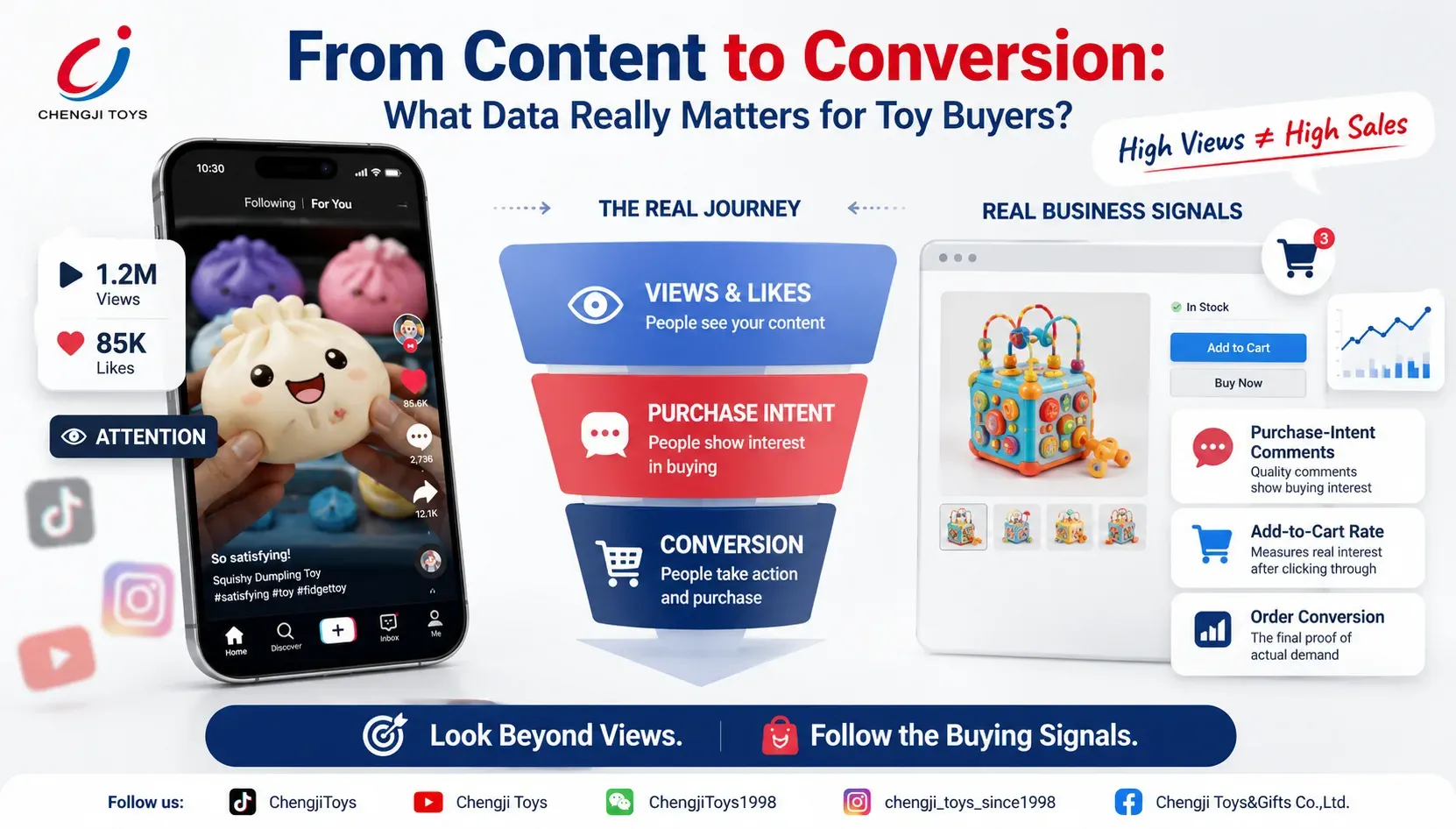
High social media attention does not automatically mean strong sales potential.
A viral video may perform well because of the creator, storytelling, editing style, or entertainment value rather than the product itself.
For sourcing decisions, the better question is not simply:
“How many views did this product get?”
It is:
“Did that attention create real buying behavior?”
To answer that question, toy buyers need to look beyond views and likes and focus on stronger commercial signals.
1. Why Viral Views Do Not Always Mean Strong Sales
Views and likes mainly measure content performance.
They tell us whether people stopped scrolling, watched the video, or reacted to the content. They do not directly tell us whether viewers actually want to buy the product.
A video may perform well because of:
- creator influence
- entertaining storytelling
- visual effects
- novelty
- algorithm exposure
- a strong opening hook
The product itself may still be ordinary.
Once the toy is separated from the creator or the original content environment, its commercial performance can be very different.
This is why buyers should distinguish between two types of data:
Content Metric → Did people watch?
Commerce Metric → Did people want to buy?
A product with millions of views but little purchase interest may be a weaker sourcing opportunity than a product with moderate traffic but strong buying signals.
2. The 3 Data Layers Toy Buyers Should Check
Instead of using one number to decide whether a product is worth sourcing, buyers can evaluate social-media products through three levels of evidence.

Level 1: Purchase Intent in the Comment Section
One of the easiest signals to observe is the quality of the comments.
A large number of comments does not necessarily indicate buying demand. What matters is what people are actually saying.
Comments such as:
- “Where can I buy this?”
- “Do you have the link?”
- “How much is it?”
- “Where can I order?”
- “I need this.”
- “My child would love this.”
are much stronger commercial signals than simple reactions such as:
- “Cute!”
- “Amazing!”
- “LOL”
- emojis only
The more purchase-related questions appear in the discussion, the stronger the indication that viewers are moving from passive entertainment toward real product interest.
For toy buyers, the useful question is therefore not:
“How many comments does this video have?”
but:
“What percentage of those comments show real purchase intent?”
A product with 100,000 views and a high level of “where to buy” comments may deserve more attention than one with 2 million views but almost no purchase-related discussion.
Level 2: Sustained Engagement Across Content
The next question is whether interest continues beyond one viral post.
A product that performs well only once may have benefited from:
- one strong creator
- a particular video concept
- temporary novelty
- short-lived algorithm exposure
A stronger product signal appears when similar interest can be found across multiple posts or different creators.
Useful indicators include:
- strong completion rate, when available
- saves and shares
- repeat appearance of the product in successful content
- continued engagement after the first viral spike
- similar performance across different creators or accounts
This helps buyers separate product appeal from creator appeal.
For example, if one creator makes a toy go viral, the creator may be the main reason for the success.
But if the same toy generates interest across three different accounts, different audiences, and different content styles, confidence in the product itself becomes much stronger.
This is why buyers should avoid judging a product from one screenshot or one viral video.
Look for consistency, not just a single peak.
Level 3: Add-to-Cart and Conversion — The Final Test
The strongest signal is what happens after people leave social media.
Do viewers:
- visit the product page?
- click the purchase link?
- add the product to cart?
- submit an inquiry?
- request samples?
- place an order?
This is where attention becomes commercial evidence.
The process can be viewed simply as:
Social Media Traffic → Product Page → Add to Cart → Order
Social media tells you whether people notice the product.
Conversion data tells you whether the product can become a business.
That is why add-to-cart rate, inquiry rate, and actual conversion should carry more weight in sourcing decisions than views or likes alone.
A product with moderate social engagement but strong conversion may be much safer to scale than a product with huge traffic but weak purchasing behavior.
Social Media Data: What Does Each Metric Really Tell You?
| Metric | What It Mainly Shows | Sourcing Value |
| Views | Content reach | Low |
| Likes | Basic engagement | Low–Medium |
| Saves / Shares | Stronger interest | Medium |
| Purchase-intent comments | Buying curiosity | High |
| Performance across creators | Product-level consistency | High |
| Add-to-cart rate | Commercial intent | Very High |
| Order conversion | Actual market demand | Highest |
The further the customer moves toward an actual purchase, the more useful the data becomes for sourcing decisions.
In simple terms:
Views show attention.
Comments show intent.
Conversions show business potential.
3. A Practical Social-Media Sourcing Workflow
Social media should be used as a discovery tool, but the sourcing decision should be supported by several layers of validation.
A practical process can follow four steps.
Step 1: Cross-Check the Trend
Do not make a large sourcing decision based on one viral video.
Search for the same or similar product across at least 2–3 different creators, accounts, or content styles.
Look for:
- repeated product appearance
- consistent audience reaction
- purchase-related comments
- whether attention continues over time
If only one creator can make the product look attractive, the risk may be higher.
If several unrelated creators achieve similar results, the product signal is stronger.
Step 2: Check Buying Signals
After confirming that the trend is not limited to one post, look deeper into the engagement.
Prioritize content that shows:
- purchase links
- product tags
- store landing pages
- “where to buy” comments
- saves and shares
- clear product questions
- visible commercial interaction
Content connected to a real purchase path provides more sourcing value than content created purely for entertainment.
A funny video may create millions of views.
A product video that repeatedly sends customers to a store may create a business.
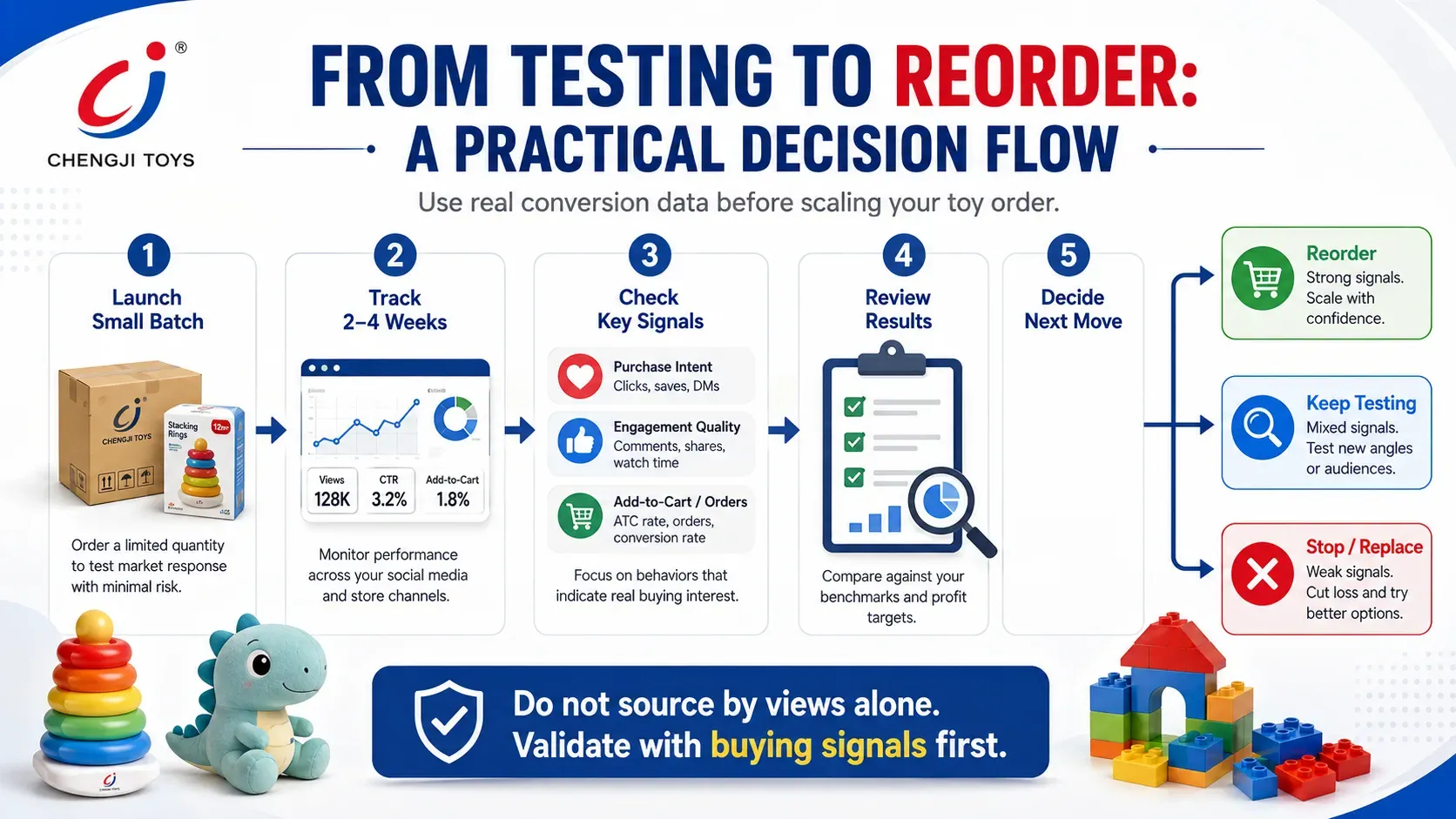
Step 3: Validate with a Small Test
Even when social signals look strong, buyers do not need to immediately place a large-volume order.
A controlled trial can provide much better information.
For example:
- Select a small number of promising products.
- Launch them in your actual sales channel.
- Monitor product-page visits and inquiries.
- Track add-to-cart and sell-through performance.
- Collect customer feedback.
- Compare actual results with the original social-media signals.
This helps turn a trend assumption into measurable commercial data.
For many toy buyers, small-batch validation is the bridge between social-media discovery and bulk purchasing.
Step 4: Scale Only After Conversion
If the test shows strong commercial performance, buyers can gradually increase the order quantity.
If the product generates attention but weak conversion, there may be no reason to continue increasing inventory.
The decision can remain simple:
Strong Conversion → Reorder / Scale
Mixed Results → Continue Testing
Weak Conversion → Reduce Exposure / Stop
This approach helps buyers respond quickly while avoiding excessive inventory caused by short-lived social trends.
4. Social Media Should Start the Decision — Not Finish It
Social media is valuable because it helps buyers discover products earlier.
It can reveal:
- emerging toy trends
- changing consumer interests
- new product formats
- new play patterns
- visual styles attracting attention
But social-media popularity should be treated as the first signal, not the final sourcing decision.
A stronger decision process moves through several stages:
Attention → Interest → Purchase Intent → Conversion
As the customer moves further through this path, the sourcing evidence becomes stronger.
This is especially important in the toy market, where visual novelty can create sudden traffic but product lifecycles may change quickly.
The objective is not to avoid trends.
The objective is to identify which trends are supported by real buying behavior.
Final Thoughts
Social media is excellent for discovering opportunities, but attention alone does not validate demand.
Before scaling a trending toy, buyers should look for three levels of evidence:
Attention → Purchase Intent → Conversion
The strongest product opportunities are not necessarily those with the highest view counts. They are the products that can consistently turn consumer attention into measurable buying behavior.
If you are testing social-media-driven toy ideas, Chengji Toys can support product recommendations, flexible trial quantities, and sourcing solutions for small-batch market validation.
Instead of moving directly from viral video to bulk order, a more practical sourcing path is:
Discover → Validate → Test → Scale
Website: chengjitoy.com
Email: [email protected]
Phone / WhatsApp / WeChat: +86-13715966567