
For many toy buyers, pricing is one of the most confusing parts of sourcing. The same-looking toy may receive quotations that differ by 20% to 30% across factories.
This does not automatically mean that the lowest-priced toy factory offers the best value or that the highest quotation is unreasonable. A toy quotation may reflect different material grades, quality-control standards, testing requirements, packaging details, order quantities, production schedules, and after-sales responsibilities.
To compare quotations accurately, buyers need to understand what is included behind the final number.
Why Can the Same Toy Be Quoted So Differently?
A large price gap usually does not come from one factor alone. It is often the result of several differences in the production and service structure.
1. Material Grade
Two toys may look almost identical while using very different materials.
For example, a product made with virgin ABS may cost more than one made with recycled or lower-grade plastic. The difference may affect product strength, color consistency, surface finish, durability, and compliance performance.
These differences are not always visible in a product photo. Therefore, the same appearance does not necessarily mean the same production standard.
Before comparing prices, buyers should confirm:
- material type
- material grade
- whether the approved sample and bulk production use the same standard
2. Quality Control and Testing
Inspection and compliance support can also affect the quotation.
A lower quotation may be based on basic toy factory inspection or random checks only. Another supplier may include stricter production control, more detailed inspection, testing coordination, or existing test reports.
Buyers should clarify whether the price includes:
- in-house inspection
- full inspection or random inspection
- third-party testing
- compliance documents or test reports
- additional testing fees
For products entering regulated markets, testing and quality control are part of the real sourcing cost—not optional extras.
3. MOQ and Production Scheduling
The quoted unit price is closely connected to order quantity and production conditions.
A particularly low price may only apply to:
- large-volume orders
- full production runs
- toy factory-preferred quantities
- standard production schedules
Small trial orders, urgent orders, or orders requiring special scheduling may cost more because the toy factory needs to purchase smaller material quantities, change production arrangements, or insert the order into an existing schedule.
This is why buyers should always check the MOQ and quantity basis behind the quoted price.
4. After-Sales Responsibility
Not every quotation includes the same level of responsibility after shipment.
Some suppliers may include support for:
- defective-product replacement
- broken-item replenishment
- rework or repair
- clearer responsibility handling
- after-sales coordination
A lower quotation may simply leave more of these risks to the buyer.
The important question is not only how much the product costs, but also who will bear the cost if something goes wrong.
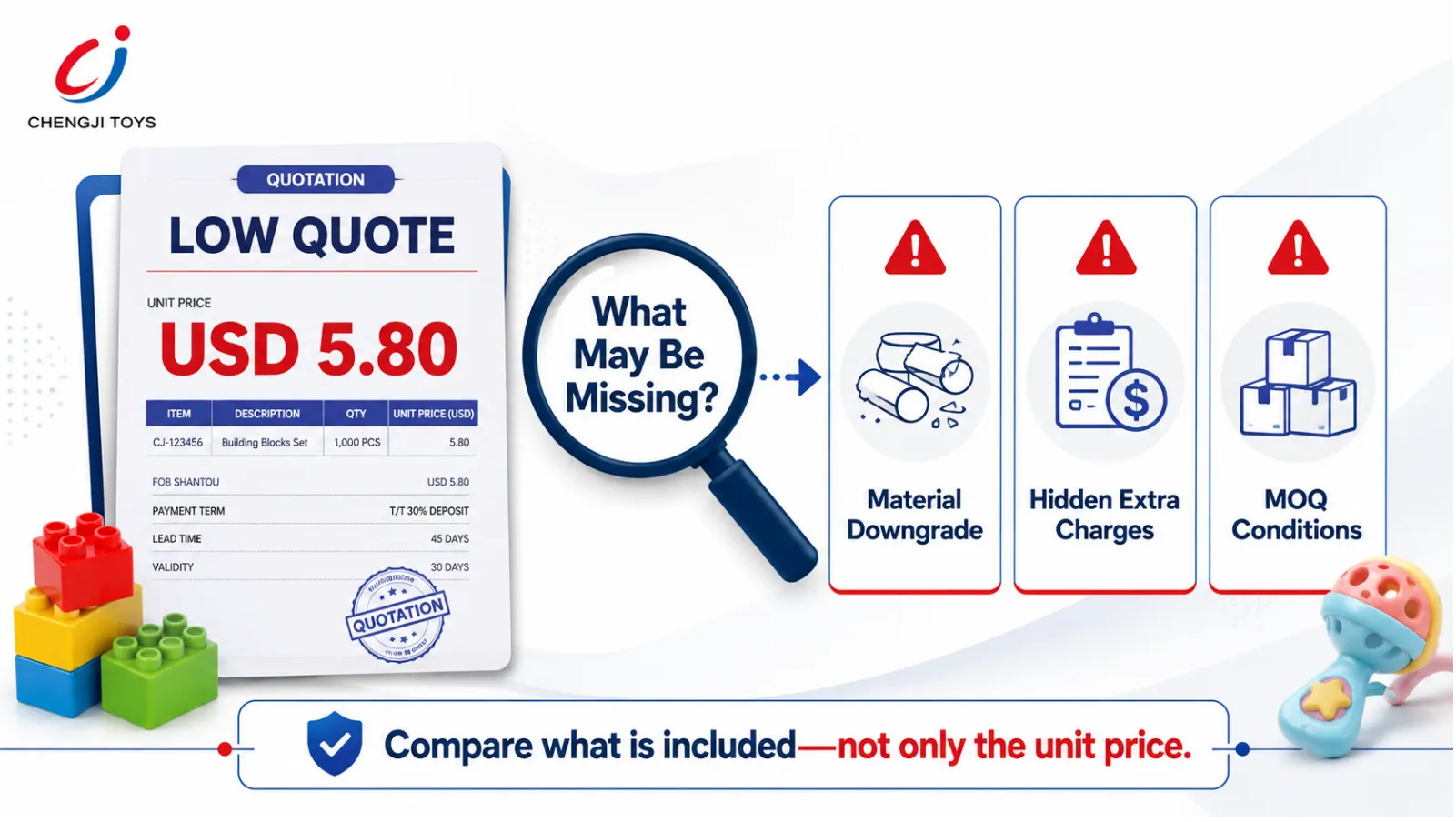
Three Common Traps in Low Toy Factory Quotations
A low quotation can be competitive, but it should also be clear and complete. Buyers should pay particular attention to the following risks.
1. Material Downgrade
The quotation may not clearly state the material grade, creating a risk that bulk production uses a lower standard than the approved sample.
This can lead to differences in:
- product strength
- appearance
- color consistency
- safety performance
- customer satisfaction
The material requirement should be confirmed in writing before production.
2. Hidden Extra Charges
Some quotations look attractive because important costs are not included at the beginning.
Additional charges may later appear for:
- color boxes or packaging
- export carton upgrades
- pallets or wooden frames
- labels and stickers
- inspection
- loading or handling
- special packing requirements
A quotation should clearly state what is included and which costs will be charged separately.
3. MOQ Pricing Conditions
A very low unit price may only apply to full-container quantities or a much higher MOQ than the buyer actually needs.
Trial orders and smaller orders may use a different pricing structure. If this condition is not explained clearly, the first quotation can create a misleading price impression.
Buyers should always request prices based on their actual order quantity.
A Practical Checklist for Comparing Toy Quotations
A meaningful comparison is only possible when suppliers quote under the same conditions. Otherwise, the buyer may be comparing products with different quality and service standards.
| Comparison Item | What Buyers Should Confirm |
| Product Specification | Same design, size, function, accessories, and battery configuration |
| Material | Material type, grade, thickness, and approved standard |
| Packaging | Color box, window box, display box, carton quality, labels, and inserts |
| Testing and Inspection | Required standards, test reports, inspection level, and included fees |
| Order Quantity | MOQ, actual order quantity, and quantity-based price levels |
| Delivery Terms | EXW, FOB, or other terms, including the named port or location |
| Production Schedule | Standard lead time, urgent-order fees, and production-slot conditions |
| Additional Costs | Mold, artwork, printing, pallet, inspection, loading, or handling fees |
| After-Sales Support | Replacement, replenishment, rework, and responsibility for defects |
Before choosing a supplier, buyers should ask:
Are all quotations based on the same material, packaging, testing, quantity, and delivery conditions?
Only then does the price comparison become meaningful.
Why Transparency Matters More Than the Lowest Price
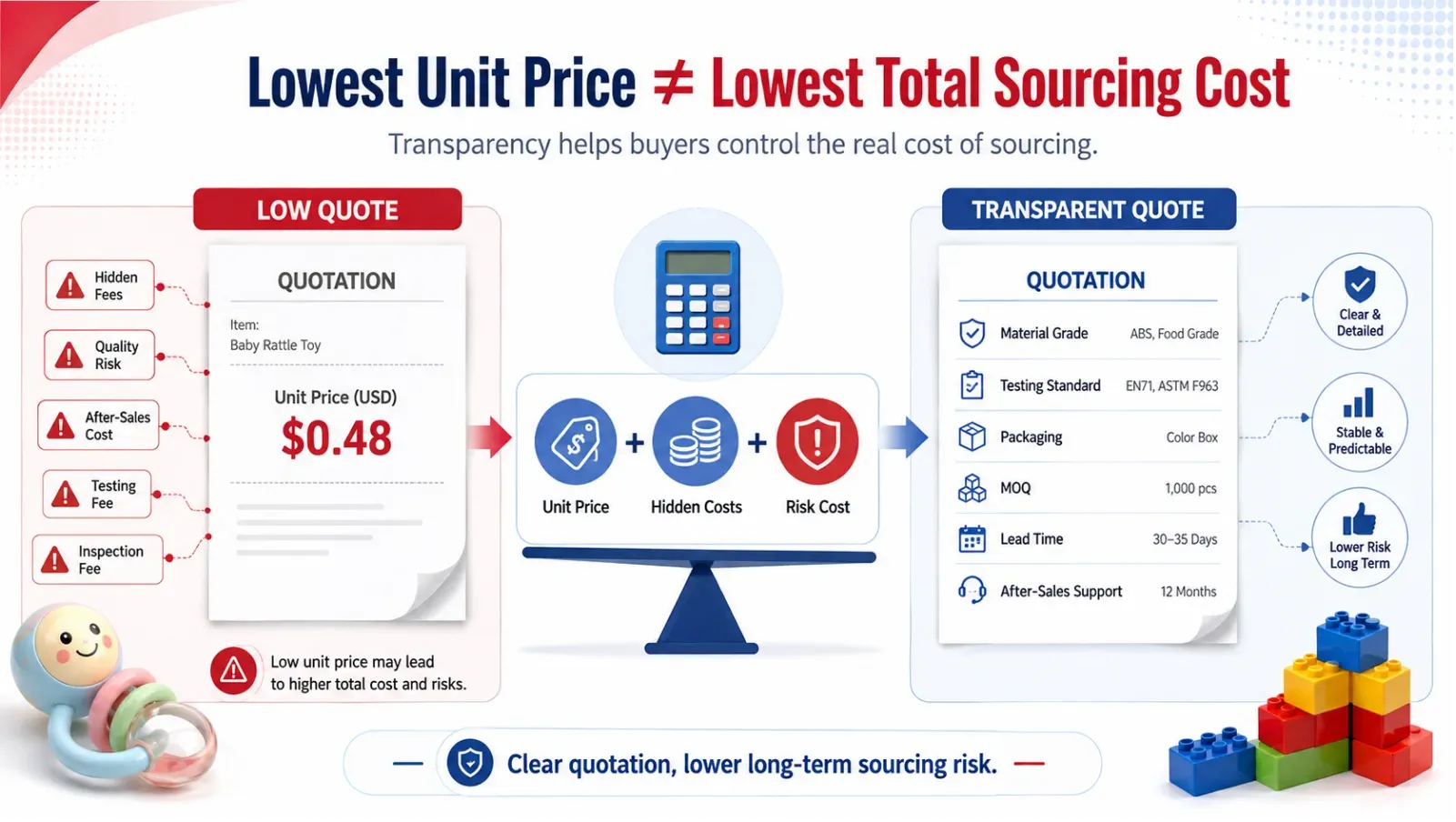
The lowest quotation is not always the lowest total sourcing cost.
A slightly higher but clearer quotation may provide:
- more consistent materials
- more stable bulk quality
- better compliance support
- fewer unexpected charges
- lower after-sales risk
- easier long-term cooperation
By contrast, a low quotation with unclear conditions may create extra expenses during production, inspection, shipment, or after-sales handling.
Factories that explain their pricing structure clearly are generally easier to evaluate and manage. Transparency helps buyers understand what they are paying for and what may cause the price to change.
Final Thoughts
A good toy quotation is not simply the lowest number. It is a price based on clear specifications, materials, testing requirements, order quantity, packaging, delivery terms, and service responsibilities.
Instead of asking only:
“Which toy factory is cheaper?”
Buyers should also ask:
“What exactly is included in this price?”
A transparent quotation makes supplier comparison easier, reduces hidden risks, and supports more stable sourcing decisions.
To receive a standardized transparent quotation template or a toy material-grade guide, contact Chengji Toys.
Website: chengjitoy.com
Email: [email protected]
Phone / WhatsApp / WeChat: +86-13715966567