
A shipment can arrive at the port on time and still miss its selling window. Here is how FBA sellers, overseas warehouse wholesalers, and retail buyers can plan October decisions around the date their stock actually needs to be ready.
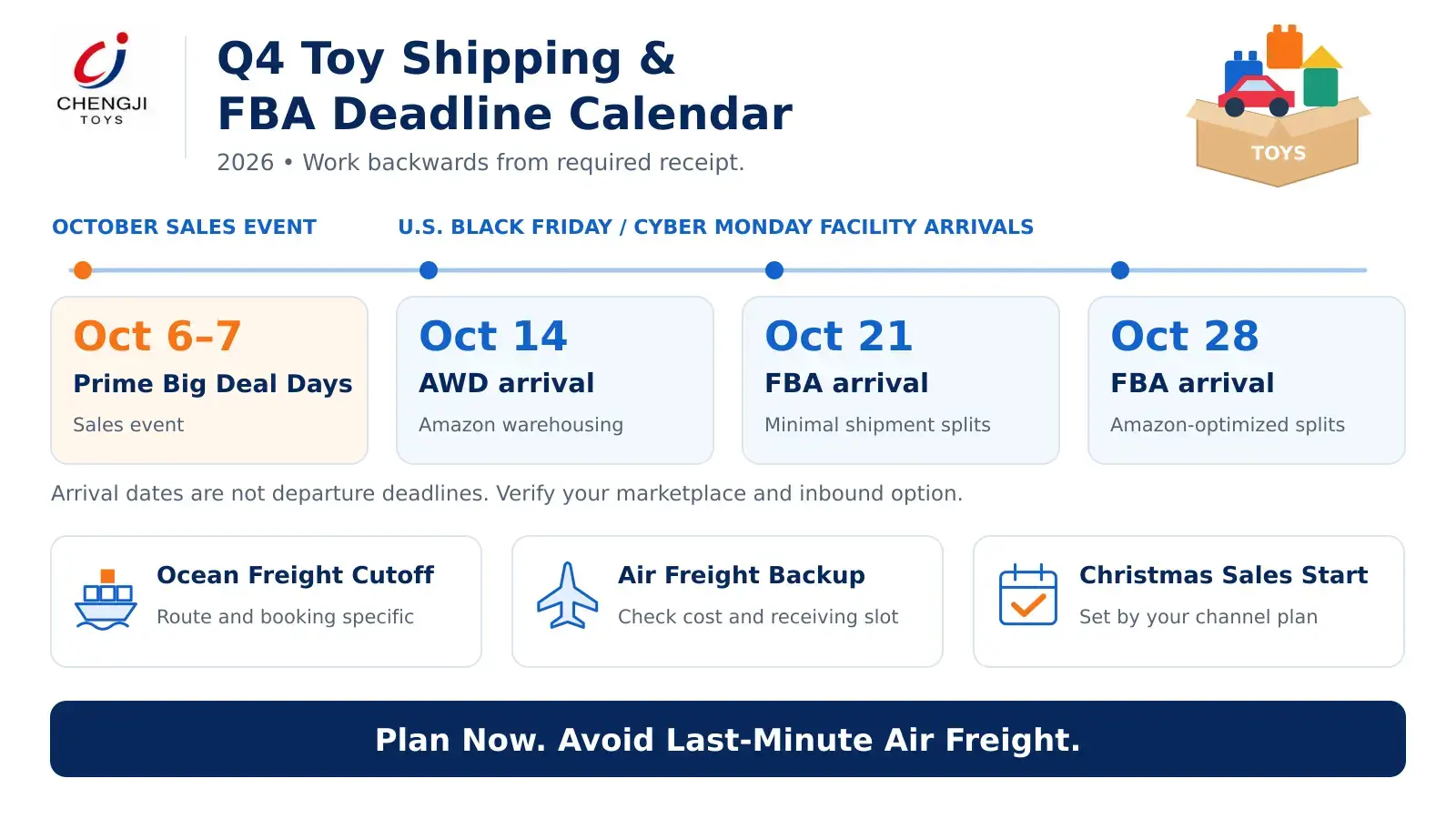
With Prime Big Deal Days on October 6–7 now behind us, Christmas toy replenishment moves into a more time-sensitive phase. Amazon confirmed those dates for its 2026 event.[1] The next question for buyers is practical: can the required products reach the right sales channel at a cost the order can support?
For cross-border sellers, warehouse-based wholesalers and store buyers, October is the point to turn forecasts into confirmed production, transport and receiving plans. An attractive unit price has limited value if a late shipment leaves stock unavailable during a promotion—or creates an air freight bill that consumes the margin.
Start with the required receiving or on-sale date, then work backwards through every stage. Factory completion, vessel departure, port arrival, warehouse receipt, and sellable inventory are different milestones. Your plan needs to connect them.
1. The October Window: What Is Confirmed, and What You Must Calculate
Prime Big Deal Days can provide an early demand signal, but a short promotion should not become the entire Christmas forecast. Review normal sales, promotion-driven demand, stock already committed to customers, and confirmed incoming supply before placing the next order.
For the United States, Amazon has published the following facility-arrival dates for its 2026 Black Friday Week and Cyber Monday preparation:[2]
| U.S. inbound route | Published arrival date | What the date means |
|---|---|---|
| Amazon Warehousing and Distribution (AWD) | October 14, 2026 | Arrival at the relevant Amazon facility |
| FBA: minimal shipment splits | October 21, 2026 | Arrival for the selected inbound option |
| FBA: Amazon-optimized shipment splits | October 28, 2026 | Arrival for the selected inbound option |
These are U.S. event-related arrival dates, not China departure dates or a universal Christmas cutoff. Check the current notice, shipment option, and delivery window in your own Seller Central account. Other marketplaces require their own confirmation.
Amazon also warns that inventory arriving after its stated cutoffs may not be processed in time.[3] Paying for a faster international journey does not itself secure a receiving appointment or make stock immediately available for sale.
The transport side also needs a current check. Maersk’s September 2026 North America update reported transpacific shipment backlogs following Asian typhoons and pressure on selected air freight origins.[4] That is a reason to confirm the actual service and gateway, rather than assume every Q4 route has the same delay.
2. Different Channels Need Different Receiving Plans
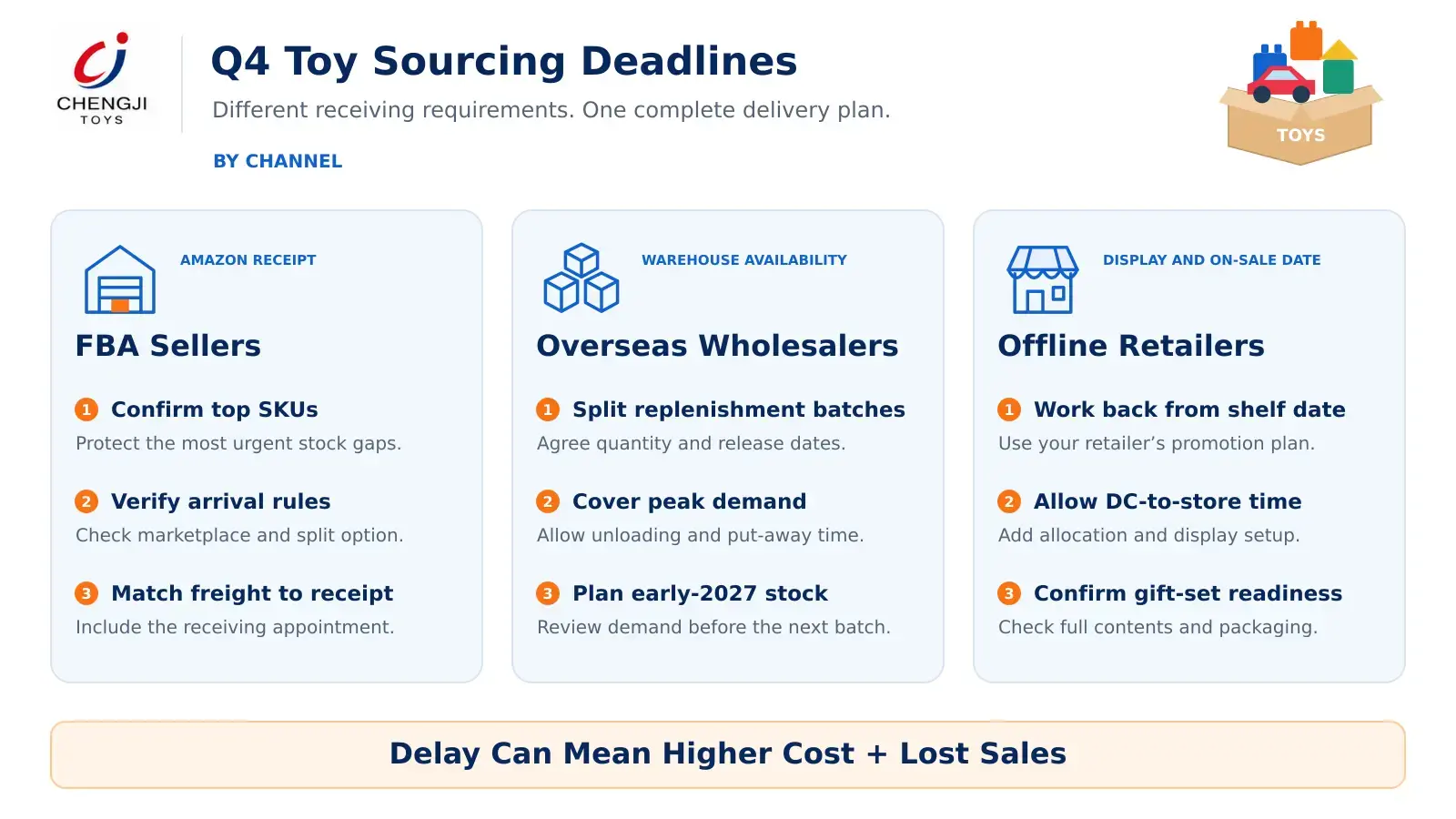
FBA Sellers: Plan for Amazon Receipt and Inventory Availability
Begin with the relevant Amazon arrival requirement and the stock level needed for your promotion. Then check the assigned destinations, shipment configuration, available capacity, preparation requirements, and delivery arrangements.
If goods are still awaiting production in China after the October event, do not assume a standard ocean shipment can meet a late-October U.S. arrival target. Ask your forwarder for an end-to-end schedule, including origin handling, international movement, customs, and delivery to the assigned facility.
Prioritize SKUs with a documented stock gap and a viable margin. If a faster service is needed, reserve it for the quantity that protects the most important selling period. Confirm the downstream receiving plan before approving the premium.
Overseas Warehouse Wholesalers: Link Peak Replenishment With Early 2027
An independent overseas warehouse follows its own receiving and dispatch arrangements. Stock delivered there may still need unloading, counting, labelling, put-away or order allocation before it can serve buyers.
Plan at least two decision points: an initial replenishment for the Christmas selling period, and a later release based on updated demand and early-2027 requirements. Set the quantity, goods-ready date, and shipment deadline for each release in writing.
Split delivery does not automatically mean flexible payment or unlimited quantity changes. Confirm deposits, minimum production batches, storage charges, packaging commitments, and the last date for adjusting later quantities. Ask factories and logistics partners about their actual shutdown schedules when planning supply around Chinese New Year.
Offline Retail and Gift Channels: Work Back From the Display Date
Retailers need the products ready for allocation, shelf placement and promotion. A late-October warehouse target can be sensible for an early-November display launch, but it should follow the retailer’s calendar rather than be treated as an industry-wide rule.
For example, if stores need their Christmas gift sets on November 2 and distribution takes ten calendar days, the distribution centre needs receipt by October 23. The port arrival must be earlier still.
Confirm purchase-order delivery windows, booking references, carton labels, packing lists and any display assembly time. For gift sets, check that the complete contents, retail presentation and protective export packing are ready together. A missing accessory or damaged gift box can delay an otherwise timely launch.
3. Calculate the Last Feasible Goods-Ready and Departure Dates
Request a schedule that separates the following stages: origin handover and export handling; international transit; destination clearance and delivery; warehouse processing or onward distribution; and an explicit disruption allowance. Maersk’s freight guide makes the same basic distinction between the sailing time and the complete journey.[5]
Latest goods-ready date
Required facility-arrival date − origin handling − international transit − destination clearance and delivery − contingency
If you start with an on-sale date, first subtract receiving, put-away, and any onward distribution time to find the facility-arrival target. Then subtract production, sample approval and any testing still required to find the latest order-release date.
A Worked Example: The Same Transport Assumptions, Three Different Deadlines
The example below assumes four calendar days at origin, twenty days in international transit, four days for destination clearance and delivery, and seven days of contingency. That is thirty-five days from goods-ready to required receipt. These are calculation inputs, not quoted transit times for a real route.
| Example requirement | Required facility arrival | Latest goods-ready date | Latest planned departure |
|---|---|---|---|
| U.S. FBA optimized-split arrival target | Oct 28 | Sep 23 | Sep 27 |
| Buyer-selected overseas warehouse receipt | Nov 16 | Oct 12 | Oct 16 |
| Retail DC receipt for Nov 2 display, allowing 10 days onward distribution | Oct 23 | Sep 18 | Sep 22 |
All example dates are in 2026. The FBA arrival target comes from Amazon; the other targets and all transport durations are assumptions. Recalculate using your confirmed route, business-day calendars, sailing schedule, and booking cutoffs. Vessel or terminal cargo cutoffs can fall before the departure date.
The implication after October 7 is clear: on these assumptions, a fresh standard-ocean dispatch would already miss the FBA and retail targets. The November warehouse target could remain feasible for goods ready by October 12. A faster service, existing destination stock, a smaller urgent batch, or a revised selling plan needs evaluation where the original route no longer fits.
4. Three Q4 Mistakes That Can Turn a Good Order Into an Expensive One
Mistake 1: Treating the Sailing Schedule as a Complete Delivery Promise
A vessel’s estimated arrival leaves destination handling and warehouse receipt to be completed. Ask who owns each leg, which dates are booked, which remain estimates, and when an alternative must be activated. Recheck the plan when production slips or the routing changes; do not silently consume every day of buffer.
Mistake 2: Comparing Factory Prices Without Comparing the Cost to Sell
Include freight, surcharges, handling, customs-related costs, destination delivery, warehouse charges, and any repacking in the comparison. Use the same cost scope for standard ocean, expedited ocean, and air quotations.
Bulky toy gift sets can be especially sensitive to air freight pricing. DHL explains that chargeable weight compares physical weight with dimensional weight, and the larger figure can determine the charge; the applicable ratio must be checked with the carrier.[6] Provide packed carton dimensions and gross weights before comparing quotes.
For a hypothetical 1,000-unit order, an extra $4 per unit to expedite the whole shipment adds $4,000. If only 200 units are needed to bridge a short stock gap, that same assumed incremental rate adds $800 for the urgent portion—before extra split-shipment fees. Neither figure is a market freight quote. The useful question is how much profitable demand the urgent quantity can realistically protect.
Mistake 3: Committing Every SKU and Every Unit at Once
Separate proven replenishment lines from seasonal experiments. Compare the expected sell-through of building sets, indoor activity toys, interactive toys, and gift assortments using your own channel data. Fast sales during a discount event may not continue at the same rate after the price returns to normal.
Use a confirmed first release and a defined review point for later stock. Check the extra freight minimums and production costs before assuming smaller batches will reduce the total cost.
5. A Five-Step Check Before Releasing the Next Shipment
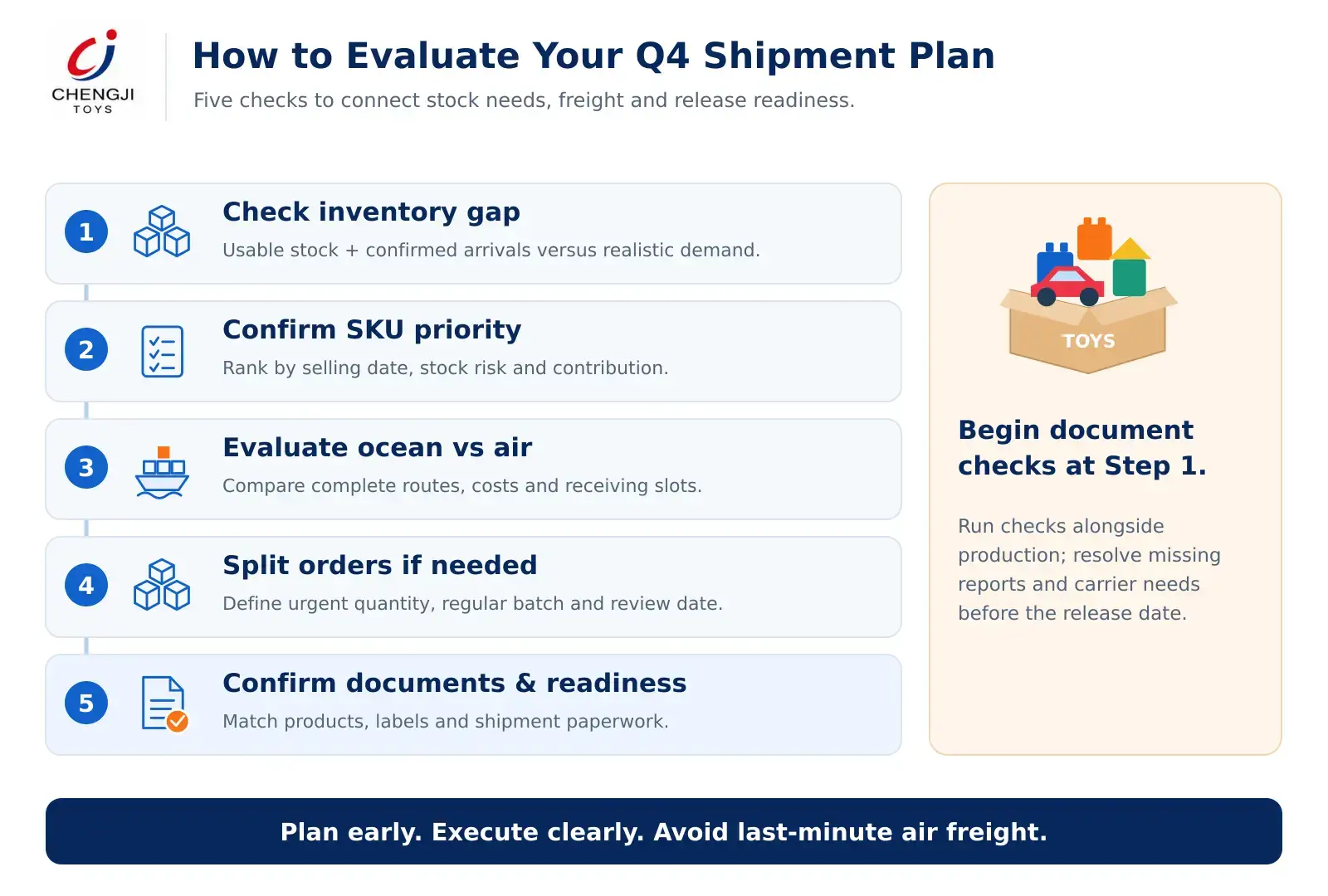
- Check the inventory gap. Count usable stock and confirmed arrivals against expected demand, customer commitments, and the planned buffer.
- Confirm SKU priority. Rank lines by selling deadline, stock risk, expected contribution, and how easily demand can be served from existing stock.
- Evaluate ocean, expedited ocean and air. Compare the full delivery plan, chargeable weight, costs and receiving arrangements—not just the main transport leg.
- Split orders where the numbers support it. Identify the urgent quantity, the regular replenishment batch, and the decision date for any later release.
- Confirm documents and release readiness. Match the goods, packing list, invoice, labels, and product-specific documentation to the destination and channel before dispatch.
Document checks should start with the initial SKU review and run alongside production. Existing reports need to match the product and intended market; any missing testing or carrier acceptance requirement can affect the schedule. For battery-powered or liquid-containing toys, raise the product details with the forwarder when requesting the transport plan.
6. Chengji Toys’ Approach: Flexible Production and Phased Shipments
Based in the Chenghai toy sourcing cluster, Chengji Toys helps buyers connect product requirements with factory coordination and shipment preparation. For a time-sensitive Q4 enquiry, the first task is to establish what can be ready, when it must arrive, and which execution options remain workable.

Our support can include:
- Production coordination: checking stock or production availability and discussing priority scheduling with partner factories, subject to confirmed capacity and specifications.
- Phased shipment support: separating urgent lines from regular replenishment and agreeing the quantities, release dates, and commercial terms for each batch.
- Transport-plan coordination: working with your appointed forwarder or discussing available logistics options to compare the timing and cost of suitable services.
- Documentation and follow-up: coordinating available product reports, packing information and shipment preparation requirements, with a clear contact for progress updates.
Any additional testing, special preparation, expedited handling, or storage should be identified and priced where applicable. A practical plan makes these dependencies visible before the buyer commits to the shipment.
Sources and Planning Scope
Official notices and logistics guidance checked on October 5, 2026. Recheck current marketplace and carrier requirements before booking.
- Amazon: Prime Big Deal Days 2026 announcement.
- Amazon U.S. Seller Central: Holiday 2026 inbound inventory dates.
- Amazon U.S. Seller Forums: Q4 inventory timing guidance.
- Maersk: North America market update, September 2026.
- Maersk: Ocean freight transit planning guide.
- DHL Global Forwarding: Chargeable weight explained.
TURN YOUR TARGET DATE INTO A SHIPMENT PLAN
Need a Q4 Toy Replenishment Assessment?
Send Chengji Toys your target SKUs, quantities, destination country and warehouse or postcode, sales channel, current stock position, and required receiving or on-sale date. If available, include the carton dimensions, gross weights, and applicable Amazon arrival requirements.
We can review product readiness, discuss phased production and shipment options, and help identify the next decisions with your logistics partner. The aim is to keep the plan commercially workable while there is still time to act.
Site web : chengjitoy.com
Courriel : [email protected]
Téléphone / WhatsApp / WeChat : +86-13715966567